• June 16, 2026 – Fasting to Seek God — Acts #44
    Acts. 13:1-3

    This week we continue looking at Acts 13, at that particular worship service held in 45 AD in the city of Antioch.  This was a momentous day in the New Testament, for it was on this day that the Spirit of God spoke to the church and told them to send out Saul and Barnabas on a missionary journey that would change the world.  This is a church service I want to attend, where the Spirit speaks and reveals exactly what the church’s mission is.  We need to hear the Spirit’s voice today.  We need God’s direction for our church and for every church.  

    So we are looking at the elements of this particular worship service in Antioch.  At this service, we are told they were praying and fasting.  It is prayer and fasting this day that sensitizes their hearts to hear the Spirit of God.  And it is after more prayer and fasting that they follow the Spirit’s instruction and send out Paul and Barnabas.  We can not underestimate the importance of prayer and fasting in the life of the church.

    So last week we went back to the Old Testament and looked at the basics of prayer. And how prayer is a fulfillment of God’s desire for us to have a relationship with Him.    We were created to relate to God.   That is why God was with Adam and Eve in the Garden.  That is why he delivered Israel from Egypt and had the tabernacle constructed — so He could live among them.  That is why He sent Jesus to conquer sin and death.  Everything God has done in the Bible after Genesis 3 is for the purpose of restablishing a relationship with us and living with us forever.

    Sadly, though, to many people, prayer is just a few words said before a meal, a structured prayer quickly said with a child before bedtime, or a request for something from God.  God gave His Son so that we could have a relationship with Him, yet so many don’t bother to speak to or listen to Him.  We do not know God as we could, and we do not experience the power of God in our world because we do not pray as we should.  And if prayer is underutilized in our churches today, how much more is fasting ignored by God’s people in our time?

    People are very confused about fasting.  The world has defined fasting in very different ways than the Bible.  Fasting for health benefits, especially intermittent fasting, has become very popular.  The church, however, has, except for a few denominations, once a year, completely ignored the concept of fasting.  And even in the season of Lent, fasting bears little resemblance to fasting in the Bible. 

    Most Christians I know today treat fasting as if it were optional for followers of Jesus.  So let me ask you, “Is fasting a command or is it optional?”  If we look in the Bible, we find one day each year when God commanded fasting.  

    Leviticus 16:29   And it shall be a statute to you forever that in the seventh month, on the tenth day of the month, you shall afflict yourselves and shall do no work, either the native or the stranger who sojourns among you.

    The Hebrew phrase that is translated “afflict yourselves” here is an idiom for fasting in the Bible.  Fasting on the Day of Atonement is mandatory for Israel.  Nowhere else can I find a command to fast.  However, many scriptures make it clear that while there is no other specific day on which a fast is commanded, fasting is certainly expected.  

    As followers of Jesus, we are supposed to follow the example of Jesus.  And we know of one particular fast Jesus did immediately after his baptism.  He went to the wilderness of Judea and fasted for 40 days.  And then Matthew gives us this verse:

    Matthew 4:2   And after fasting forty days and forty nights, he was hungry.

    Listen, sometimes scripture is hard to understand, and we are supposed to study and meditate on it.  This is not one of those times.  Jesus is in a desert land by himself with just a few scrub brushes and no food for over a month, and Matthew says, guess what? He got hungry.  Okay, I think most of us would have figured that out.

    But seriously, it is at this time that the adversary comes to tempt him.  (Side note:  This is when you get tempted.  When you are at your weakest, when you are all alone, when you are desperate for something.)  And Jesus’ response was to quote a verse from Deuteronomy.  

    Matthew 4:3-4   And the tempter came and said to him, “If you are the Son of God, command these stones to become loaves of bread.”

    But he answered, “It is written, “Man shall not live by bread alone, but by every word that comes from the mouth of God.’”

    Jesus tells the tempter that His fast is not over yet and that He needs to spend time with the Father more than He needs food.  His relationship to the Father is more important than food, even when he hasn’t eaten in 40 days.  So we know Jesus fasted. 

    And he is our model.  If we are followers of Jesus, we do as he did.  You can’t call yourself a follower of Jesus if you don’t walk the path he walked.  Jesus also expected his followers to fast.  In the Sermon on the Mount, Jesus discusses how we should not be outwardly showy in our religious observances.  He speaks of 3 aspects of worship there. 

    Matthew 6:2   Thus, when you give to the needy, sound no trumpet before you, as the hypocrites do in the synagogues and in the streets, that they may be praised by others.
    Matthew 6:5   And when you pray, you must not be like the hypocrites. For they love to stand and pray in the synagogues and at the street corners, that they may be seen by others.
    Matthew 6:16   And when you fast, do not look gloomy like the hypocrites, for they disfigure their faces that their fasting may be seen by others.

    Interestingly, no one would ever question the importance of regular prayer or the need to give to the poor, but Jesus lists fasting with these two spiritual practices and makes it seem that fasting should be an important part of your walk as well.  Notice that Jesus expects us to do all of these things.  He doesn’t say “if you give” but “when you give”.  It is not “if you pray” but “when you pray”.  And likewise, it is not “if you fast” but “when you fast”.  Jesus expects his followers to fast, and, like his examples of prayer and giving, expects you to do this without applause or praise from others.

    One reason the topic doesn’t come up often in the gospels is that Jesus did not ask His disciples to fast while He was with them.   But fasting was such a regular part of their religion that John the Baptist’s disciples were shocked to discover that Jesus’ disciples did not fast. 

    Matthew 9:14   Then John’s disciples came and asked him, “How is it that we and the Pharisees fast often, but your disciples do not fast?

    And how does Jesus answer?

    Matthew 9:15   Jesus answered, “How can the guests of the bridegroom mourn while he is with them? The time will come when the bridegroom will be taken from them; then they will fast.”

    Jesus said when He is gone, His disciples will fast.  While I am with them is not the time to fast.  But after I’m gone, then it will be time to fast.  So, according to Jesus, we should be fasting now.   But let me point out that it is not a command… we will look at that later.

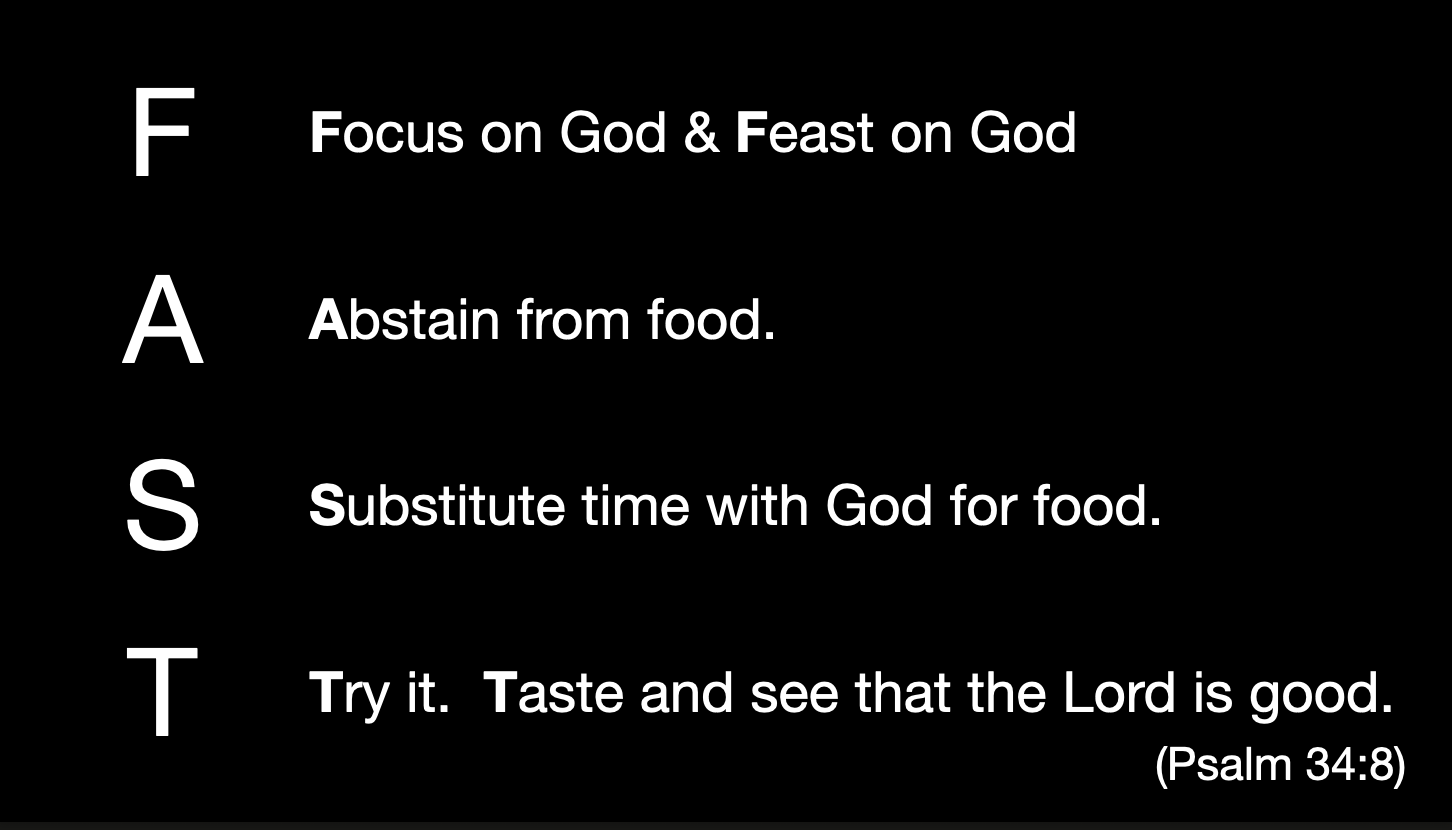
    And I will again be leaning heavily on David Platt’s discussion of this topic.  He uses an acrostic to help people remember the Biblical concept of fasting.

    F is for Focus on God and Feast on God.  That is the reason we fast.  It is not to draw attention to ourselves; it is not to lose weight or for other health benefits.  It is to fulfill God’s plan for us to build a relationship with him.  And in fasting, we grow closer to God because we take that time to feast on God.  When we fast, we are saying that we need God more than we need food.  We need God more than we need His blessings.

    Last week, when we were talking about the prayer of petition, I said that we can come dangerously close to idolatry when we pray for things, because we may show that we desire the things of creation more than we desire the Creator—and putting anything before God is idolatry.   Fasting is a physical demonstration of our desire for God and a relationship with God above all else.  It is putting our belief that God is above all into action.  

    When we fast, we show in our bodies that our relationship with God is indeed the most important thing to us.  That we desire the blessing of His presence more than the blessings of creation.   Fasting is a proof of our desire.  It is putting your money where your mouth is, because the first part of fasting is focusing on God and feasting on God.  We fast because we are hungry for God’s presence in our lives. 

    Hunger and thirst are the most basic drives for humans.  Before birth, babies get a continuous infusion of glucose from their mother.  At the time of birth, when the umbilical cord is cut, for the first time in their lives that supply is gone.  For the first time, they know hunger.  And they must satisfy that desire to live.  Babies have to eat, and they get really loud when they don’t.

    You really don’t appreciate how good food is until you are hungry.  I am willing to bet that few of you have gone days without food other than in medical situations where they are giving you a constant infusion of IV glucose, much like before you were born.  But hunger is a powerful thing.  And see what God said to Israel,

    Deuteronomy 8:3   And he humbled you and let you hunger and fed you with manna, which you did not know, nor did your fathers know, that he might make you know that man does not live by bread alone, but man lives by every word that comes from the mouth of the LORD.

    God let them get hungry before he fed them so that they would learn dependence on Him.  So they would learn that God is more important than food.  So they would learn that they need God more than bread. This is the idea that Jesus refers to in the prayer he taught his disciples.

    “Give us this day our daily bread.”

    When you pray that prayer, remember that daily bread is not simply food, but every word that comes from the mouth of God.  God supplies all we need, but more than His food, we need Him.

    A.– Abstain from food.  True biblical fasting is abstention from food.  Now people speak about fasting from many other things.  During Lent, you hear people say that they are fasting from social media, television, or some pleasure in life.  Now, there is nothing wrong with giving up these things for a time.  In fact, there is a lot right with giving up these things for a time.  But this is really not a fast as the Bible defines it.  Fasting in the Bible is always about food.

    We put aside not just a comfort or something we enjoy, but something we have a true physical need for.  Something we have to have to live.  Something all humans crave if they have gone without it. And by putting that need aside to focus on God, we are saying, “Yes, I need food, Yehovah, but I need you more. That is the message in several psalms.

    Psalm 42:1-2   As a deer pants for the water, so pants my soul for you, O God.
    Psalm 63:1   O God, you are my God; earnestly I seek you; my soul thirsts for you; my flesh faints for you, in a dry and weary land where there is no water.

    Fasting is not about what you don’t do (eat); fasting is about what you do instead.  So you take the time you would usually spend obtaining or cooking food, and the time you would spend eating, and you spend that time in prayer, study, and meditation with God.  If you don’t do this, then you are not eating, but you are not fasting (from a Biblical definition). Every time you feel a pain of hunger, you can voice a prayer to God.   God, I am really feeling hungry right now, but that reminds me to tell you that I love you more than food.

    When we fast like this, we show God that He is more important to us than anything else.  That we desire a relationship with Him above all else.  Rich Mullins stated this so well in his song, “One Thing”:

    Everybody I know says they need just one thing.
    And what they really mean is that they need just one thing more.
    And everybody seems to think they’ve got it coming.
    Well, I know that I don’t deserve You, Lord
    .Still I want to love and serve You more and more
    You’re my one thing.

    Save me from those things that might distract me
    Please take them away and purify my heart
    I don’t want to lose the eternal for the things that are passing
    ‘Cause what will I have when the world is gone
    If it isn’t for the love that goes on and on with my one thing.

    He likely got this idea from Paul:

    Philippians 3:13-14   But one thing I do: forgetting what lies behind and straining forward to what lies ahead, I press on toward the goal for the prize of the upward call of God in Christ Jesus.”

    And what is that prize, Paul?

    Philippians 3:10-11  “that I may know him and the power of his resurrection, and may share his sufferings, becoming like him in his death, that by any means possible I may attain the resurrection from the dead.”

    And Paul got this from Jesus, who tells a short parable with this same message.

    Matthew 13:45-46. Again, the kingdom of heaven is like a merchant looking for fine pearls. When he found one of great value, he went away and sold everything he had and bought it.”

    We were created to have a relationship with God.  If we do not have that in this life, we have nothing.  That should be our one thing.  That is worth giving up everything else we have or pursue.  This is why fasting is not commanded.  Because if you love someone, you don’t have to be commanded to spend time with them; you want to spend time with them.  We are to love the lord our God with all our heart, mind, and strength.  If we love God this way, then we don’t have to be commanded to pray or fast, because we want to spend time with the one we love.

    So let’s take a look at ourselves.  Ask yourself: Do I pursue God as the psalmist did?  Do I want that relationship with God more than I would want water if I were thirsty in the desert?  

    What is that one thing I am pursuing in my life?  If you don’t see that desire for God in your life right now, if the way you live does not demonstrate that God is your “one thing”, then it is time to get very serious about your relationship with God.  If that is where you are, then you need to spend some time talking with God and saying, “I am sorry that I have ignored you.”  I am sorry that I let the things of this world distract me.  You may need to pray the prayer that Rich Mullins penned in his song:

    Save me from those things that might distract me
    Please take them away and purify my heart
    I don’t want to lose the eternal for the things that are passing
    ‘Cause what will I have when the world is gone
    If it isn’t for the love that goes on and on with my one thing.

    And let me tell you, from personal experience, as one who spent a few years ignoring God, if you go to Him in this way, and then you begin to spend time with God, with prayer and then with fasting.  Your life will change.  As you begin to spend time with God, that time that at first may seem awkward and hard will become easy and wonderful.  Prayer will take on a whole new meaning for you.  And as your relationship with God grows, your desire for Him and for the things of God will grow also.   

    So the last part of the acrostic for Fast is T – Try it. (Taste and see that the Lord is good.)

    Give it a try and see how God responds. Consider it a “taste test”.  I am not asking anyone to fast for 40 days, or a week, or even a whole day. Just give it a try.  Commit to fast just one meal a week, just for the next month, and spend that time seeking God.   I feel sure that God will honor your time with Him, and you will continue it. 

  • June 1, 2026 – Prayer Basics — Acts #43
    Acts. 13:1-3

    Last time, we looked at a man named Manaen and discussed how he ended up as a prophet and teacher in the church community of Antioch, even though he was raised in the home of Herod the Great.  Today, I want to begin to look at this worship service they were having in the church on this day in Acts 13.

    Acts 13:1-3   Now in the church at Antioch there were prophets and teachers: Barnabas, Simeon called Niger, Lucius of Cyrene, Manaen (who had been brought up with Herod the tetrarch), and Saul. While they were worshiping the Lord and fasting, the Holy Spirit said, “Set apart for me Barnabas and Saul for the work to which I have called them.” So after they had fasted and prayed, they placed their hands on them and sent them off.

    Now I don’t know about you, but this is a worship service I would like to be a part of.  The Holy Spirit speaks to the people, giving them a specific task.  And don’t miss the importance of this worship service.  The task the Spirit assigns this day becomes the greatest missionary effort in the world and becomes the basis for 14 books of the 29 books in our New Testament.  This is an incredibly important worship service.

    When was the last time you were in a worship service and the Holy Spirit spoke like this? I want desperately to hear the voice of God’s Holy Spirit giving our church instruction.  And I look at this scripture, and I want to shout out to God, “Yes! Speak to us, Lord!”  But perhaps we are not spiritually prepared for the Spirit to speak.  Perhaps our worship service is not conducive to or welcoming of the Spirit speaking.  So I have to ask, Do we worship as God desires, or are we merely following a tradition of how we worship?   What can we do to better welcome God’s voice in our service and in our lives?

    So I want to focus on particular elements of worship in the book of Acts as we encounter them in the Scripture. In the next few weeks, we will take another look at the two elements mentioned here: prayer and fasting.  The Bible says so much about prayer that we could talk about it for months.   But I want to start today with the basic ideas of prayer.  And to understand the basics of anything in the Bible, you have to begin at the beginning.

    So we go back to Genesis and see that Adam and Eve walked with God in the garden. We learn that men and women are special; we were created in the image of God.  We were created to have fellowship with God.  We are unique in His creation.  Puppies nor plants nor planets talk to God.  We were uniquely created to enjoy the blessing of relationship with God.  And we learn in Genesis that our relationship is one of partnership.  God, from the beginning, asks humans to join Him in managing his creation. 

    Genesis 1:28   And God blessed them. And God said to them, “Be fruitful and multiply and fill the earth and subdue it, and have dominion over the fish of the sea and over the birds of the heavens and over every living thing that moves on the earth.”

    This is our assignment: to subdue the earth and have dominion.  We are to rule the earth in partnership with God.  But in Genesis 3, sin broke the fellowship with God.  They disobeyed the only rule He gave them.  And the shame of their disobedience led Adam and Eve to hide.  But look what happens next.

    Genesis 3:9  “But Yehovah God called to the man and said to him, “Where are you?”

    God comes looking for them.  God desires to continue the relationship with them despite their unfaithfulness to Him.  In the midst of their sin, even as they are hiding from Him, God still pursues them.  And that is true for us today.  Our relationship with God begins with His pursuit of us, not our pursuit of Him.  We are bent towards sinning.  We do not seek God unless he calls us.  Jesus said,

    John 6:44   No one can come to Me unless the Father who sent Me draws him.

    It is God’s grace towards us as he pursues us in the midst of our sin, just as he pursued Adam and Eve in their sin.  This is an important lesson.  Know that when you wander from God, He is not going just to let you leave.  He pursues us despite our wandering from him.  God pursued you in love long ago and drew you to Him.  He will not stop pursuing you, because His love for you has not changed.  He still desires that relationship with you.  He will not stop.

    Just think about that for a few minutes.  God, the supreme being, the creator of the universe, the being who is eternal, who put the stars in place and designed everything we see, and who spoke it into existence.  He seeks you.

    But there is a huge problem.  God desires a relationship with us; he designed us to have that relationship with Him. But the relationship is broken by sin.  God is a God of justice.  Remember how he describes Himself to Moses:

    Exodus 34:6-7  “Yehovah, Yehovah, a God merciful and gracious, slow to anger, and abounding in steadfast love and faithfulness, keeping steadfast love for thousands, forgiving iniquity and transgression and sin, but who will by no means clear the guilty…”

    God will by no means clear the guilty.  He is just.  Justice must prevail. The guilty must be punished, and we are all guilty.  God told Adam and Eve the punishment for their sin, and we know it also: the wages of sin is death.  But we also know God is merciful and gracious. So there is a problem.  We have sinned, and the just punishment is death.  He does not desire for us to die and be separated from Him.  God wants to show us mercy, but he must be just.  So how does God reconcile this problem?

    This concept is so critical to understanding how God works in our world.  God designed a way for justice to prevail and for us to be spared through the role of an intercessor who would come before God and speak on our behalf to seek God’s mercy and grace.

    In this plan, revealed to Adam and Eve, an intercessor would come and defeat the serpent, take the penalty of sin on Himself so that God’s justice would be served and we could still commune with Him.  God’s plan was revealed from the beginning: His son Jesus, who became our intercessor before God.

    This is the way God designed the cosmos to work.  But Jesus is not the only intercessor.  We are called, in our partnership with God, to be intercessors for other people.  Jesus is the model for us to follow.  Let’s look at a few examples in Scripture of how we are called to partner with God as intercessors.

    In Genesis we see God pursuing Abram.  Abram was living in a pagan land when God sought him out.  And God gave Abram direction and promise.  But I want to focus on one meeting of Abraham with God.  Abraham and Lot have gone their separate ways.  And God comes with a few angels to visit Abraham.

    Genesis 18:22-26   So the men turned from there and went toward Sodom, but Abraham still stood before Yehovah. Then Abraham drew near and said, “Will you indeed sweep away the righteous with the wicked? Suppose there are fifty righteous within the city. Will you then sweep away the place and not spare it for the fifty righteous who are in it? Far be it from you to do such a thing, to put the righteous to death with the wicked, so that the righteous fare as the wicked! Far be that from you! Shall not the Judge of all the earth do what is just?” And Yehovah said, “If I find at Sodom fifty righteous in the city, I will spare the whole place for their sake.”

    And you know what happens next. Abraham bargains God down to fewer and fewer righteous people required.

    Genesis 18:31-33   He said, “Behold, I have undertaken to speak to the Lord. Suppose twenty are found there.” He answered, “For the sake of twenty I will not destroy it.” Then he said, “Oh let not the Lord be angry, and I will speak again but this once. Suppose ten are found there.” He answered, “For the sake of ten I will not destroy it.” And Yehovah went his way, when he had finished speaking to Abraham, and Abraham returned to his place.

    In this conversation with God, Abraham serves as an intercessor for those who are condemned to death for their sins.  Now, unfortunately, there were not 10 righteous found in Sodom, so it was destroyed.  But Abraham’s plea to God not to sweep away the righteous with the wicked is answered, and God spares Lot and his family from the destruction with the wicked.  All because Abraham spoke up for them.

    We are talking about prayer.  Prayer is not just “Thank you, God, for the food.”  It is not just “Please help my house sell.”  Unfortunately for some people, prayer is all about petition.  But our goal in prayer is not to get things from God.  Our goal is to know God, to love God, and to enjoy a relationship with God.  That is the central goal of prayer.  Prayer is the pursuit of God, not just His gifts.  If all you pray for is things, then you are dangerously close to idolatry, showing you want the created things more than you want the creator.  

    Our petitions to God should be primarily about people, not things.  One of the most holy privileges we have is to intercede for others in prayer to God.  And look at Abraham’s boldness before God.  Abraham is bargaining down with God as he would someone in a marketplace.  And how does God react to Abraham’s boldness?  He responds positively.

    We see that same boldness with Jacob.  He wrestles all night long with God in a dream and says, “I will not let you go until you bless me.”  Wow! Do you pray like that? That is bold.  How does God respond to Jacob’s boldness?   Why did God come to Jacob at night and start this wrestling?  Because God wanted to bless Jacob.   But Jacob had to come to the point where he could accept God’s blessing.  He had to confess who he was to God: Jacob, a deceiver, a trickster.  Only then could God bless him as he planned to do.   Philip Brooks says it this way:

    “Prayer is not conquering God’s reluctance but taking hold of God’s willingness.”1

    God wants to do so much in our lives if we will let him.  Let’s move on to Exodus and look at another example of intercession.

    In Exodus 32, Moses is up on the mountain talking to God.  Now God had invited all of Israel to come up with him, but they were too frightened by this trembling mountain of fire and smoke.  And Moses had been gone for 40 days, and they thought he died up there.  So they made a golden calf and worshiped it.  Meanwhile, up on the mountain:

    Exodus 32:7-10    And Yehovah said to Moses, “Go down, for your people, whom you brought up out of the land of Egypt, have corrupted themselves. They have turned aside quickly out of the way that I commanded them. They have made for themselves a golden calf and have worshiped it and sacrificed to it and said, ‘These are your gods, O Israel, who brought you up out of the land of Egypt!’” And the LORD said to Moses, “I have seen this people, and behold, it is a stiff-necked people. Now therefore let me alone, that my wrath may burn hot against them and I may consume them, in order that I may make a great nation of you.”

    Here is the problem. The people sinned big time.  They committed the same sin that we talked about 2 weeks ago that the shiny robed Herod Agrippa broke.  They broke the first two commandments God gave them.  They put something else above God.  So here is the judgment for their sins.  The wages of sin is death.  But Moses interceded for the people.  And what happens?

    Exodus 32:13   And Yehovah relented from the disaster that he had spoken of bringing on his people.

    Wait!  God relented.   God changed his mind?  I have struggled with the idea of God changing His mind.  We have talked about it before.  It has puzzled me because I see scriptures that seem to point both ways.  But God led me to an answer through some sermons of David Platt.  Thank you, Jesus.

    First of all, know that God’s attributes never change.  He is always holy, loving, just.  Those attributes God tells Moses in Exodus; they don’t change.

    Malachi 3:6   For I, Yehovah, do not change.
    Numbers 23:19   God is not man, that he should lie, or a son of man, that he should change his mind. Has he said, and will he not do it? Or has he spoken, and will he not fulfill it?”

    God’s purposes do not change; God’s promises do not change.  But it certainly does look like God changed his mind here in Exodus.  God told Moses the Israelites deserved death.  Then Moses spoke, and God relented.

    Remember how God designed the world.  He will exact judgment unless there is an intercessor to speak for the people. And Moses is that mediator who speaks to the people for God and who speaks to God for the people.  Moses asks for a chance for the people to repent.  This was God’s plan all along.  

    That’s why he tells Moses in verse 7 to go down from the mountain.  God could have dispensed judgment on the people right then and there.  But instead he tells Moses to go down the mountain, enlisting him as their intercessor.  God’s plan was to spare his people as they repented through the actions of their intercessor, Moses.  God is partnering with Moses to deliver His people.  Moses is an integral part of God’s plan.   

    Why does God stop by Abraham’s tent on the way to Sodom?  What is the purpose of His visit with Abraham?   He wants Abraham to intercede.   He needs Abraham to intercede.  I love how David Platt says it:

    “When Moses prays for them, he does not change God’s plan; he fulfills it.”2

    This is the outcome God desired from the beginning.   Let me jump out of Genesis for a moment and give you another example from the book of Jonah:  God says that the awful evil of the city of Nineveh has come up to him.  They are to be destroyed. In 40 days Nineveh shall be overthrown.  But at the same time, God sends a prophet to warn them.  Why? Because God didn’t want to have to destroy Nineveh.  That was his last resort to fulfill justice.  What God wanted was for Nineveh to repent so that he could show them mercy.  

    So God judges them for their sin and, at the same time, sends Jonah to warn them so they will repent.  And Jonah eventually goes, and this happens:

    Jonah 3:10   When God saw what they did, how they turned from their evil way, God relented of the disaster that he had said he would do to them, and he did not do it.

    God relented. God didn’t change His mind.   He got exactly what he wanted: the people of Nineveh repented, and He didn’t have to destroy them.   It is the same way for the Israelites in Exodus, and it is the same way for us.  We are all sinners, every one of us.  And the wages of sin is death; that is the justice we deserve.  If you sin, you will die.  We all stand under judgment for the death we deserve.  But God said to His son as He said to Moses, Go down, for the people have all sinned, and unless someone stands in the gap for them, justice requires that they all be judged.  

    1 Timothy 2:5-6   For there is one God, and there is one mediator between God and men, the man Christ Jesus, who gave himself as a ransom for all.

    Jesus is our mediator, the only one who can pay the price for our sins.  And he is our intercessor and the model for us to intercede for others.   And he brings us God’s salvation.  And look, for what purpose does God save us anyway?  We learn this in Exodus.  Why did God deliver His people then:

    Exodus 3:12   He said, “But I will be with you, and this shall be the sign for you, that I have sent you: when you have brought the people out of Egypt, you shall worship God on this mountain.
    Exodus 3:12  And I say to you, “Let my son go that he may serve me.” 
    Exodus 7:16  Let my people go, that they may serve me in the wilderness.’ Eight times the scripture says that God is delivering Israel from Egypt so they may worship him.

    God delivered them from Egypt so that they might worship Him freely, know Him more through the instruction they received at Mt Sinai, and that He might dwell with them as He had Moses construct the tabernacle.

    So why does God save us?  For the same reasons: That we might worship Him, know Him more through His Word and through prayer, and that He might dwell with us forever.  It is not so we can get our tickets punched to heaven.  Oh, God wants to dwell with us, but that begins now, not when we die.  God wants that relationship to begin now.   

    Read this passage from Exodus and picture it in your mind:

    Exodus 33:7–11   Now Moses used to take the tent and pitch it outside the camp, far off from the camp, and he called it the tent of meeting. And everyone who sought the Lord would go out to the tent of meeting, which was outside the camp. Whenever Moses went out to the tent, all the people would rise up, and each would stand at his tent door, and watch Moses until he had gone into the tent. When Moses entered the tent, the pillar of cloud would descend and stand at the entrance of the tent, and the Lord would speak with Moses. And when all the people saw the pillar of cloud standing at the entrance of the tent, all the people would rise up and worship, each at his tent door. Thus the Lord used to speak to Moses face to face, as a man speaks to his friend.

    It must have been an awesome sight.  All standing in front of their tent in silence as Moses goes into the tent of meeting to talk with God.  But think about it.  When you go to your church this week, you won’t go to stand around silently and watch someone go into a tent to talk with God.  Because now everyone can go into the tent.  But wait, it’s even better than that.  You don’t have to go into a tent, because you are the tent.  You are the temple of the Holy Spirit.  You have access to what those children of Israel could not even imagine.  Each one of us has access to God right where we sit.  We can have this experience in Exodus before we get out of bed in the morning.  This is the privilege of prayer for us.

    That brings me to a shocking verse:

    Exodus 8:13   And Yehovah did according to the word of Moses.

    The first time I read this verse, I read it, “and Moses did according to the word of Yehovah.”  That is what I was expecting to read.  But it says that God acted because Moses spoke.  

    Prayer is an invitation to join with God in affecting the course of history.   And we have primarily just looked at the first 2 books of the Bible, but if we had time to go through the rest of the Old Testament, we see that when people pray, things happen: fire falls from heaven, the sun stands still, the lame walk, the blind see, the hungry are fed, the dead come to life.  When we pray, people are given another chance to repent.

    Prayer is a powerful way we participate in His plan — He chose to design the world this way.  He doesn’t have to have us.  He could do it all without us.  But He wants to partner with us (as he told Adam and Eve in the garden).  God is inviting us, through prayer, to partner with Him to accomplish the plans He has for the world.

    When we pray, God acts.  Our prayers affect the way God acts in the world. So as we continue to go through the book of Acts, notice this:  Every major act of God in the book of Acts comes in response to the prayers of God’s people.  

    Acts 1:14   All these with one accord were devoting themselves to prayer, together with the women and Mary the mother of Jesus, and his brothers.
    Acts 2:42  And they devoted themselves to the apostles’ teaching and the fellowship, to the breaking of bread and the prayers.
    Acts 6:4   But we will devote ourselves to prayer and to the ministry of the word.

    Why were they so devoted to prayer?  Because they were completely dependent on God’s power to do anything.  And we wonder why we see so many churches where nothing seems to be happening.  Because what does a church do without prayer, without the power of Jesus?  Jesus said it:

    John 15:5   Apart from me you can do nothing.

    We need to pray.  We were created to commune with God.  We have been saved, delivered from sin, so that we may worship Him, learn more about Him through prayer and worship, and dwell with Him.  And we have been called to be intercessors for others in our community.    Listen to how the great preacher Charles Spurgeon said it:

    “Believe me, if a church does not pray, it is dead. Instead of putting united prayer last, put it first. Everything will hinge upon the power of prayer in the church.”2

    or Jonathan Edwards:

    “When God has something very great to accomplish for His church, it is His will that there should precede it, the extraordinary prayers of His people.”3

    God wants to do more in our churches than He does because we don’t ask.  It is like we are soldiers in the trenches and our mission is to take the next hill, but we can’t because we are pinned down by machine gun fire.  And we sit in the trenches, fretting that we cannot accomplish our mission because it is impossible.  So we sit, and nothing happens.  It is like we forgot we had a radio, and all we have to do is call the base and ask for air support to come in and take care of the problem.  

    James 4:2   You do not have because you do not ask.

    I believe God wants to shower his love, grace, and mercy on this community.  But He is waiting for some faithful intercessors.  Like when Peter was released from Prison, there are miracles on our doorstep, and we won’t open the door. 

    These people in Antioch in 45 AD prayed, and the Spirit spoke to them, and they sent out the greatest missionary movement in the world, a movement that turned the world upside down.  A movement that has resulted in 3 billion people following Jesus today.     What would happen if we prayed like that?  I do not know exactly what God will do if we devote ourselves to prayer.  But I know what will happen if we don’t.

    John 15:5   Apart from me you can do nothing.

    I am asking you to be a faithful intercessor.  To go before God for your community, as Moses went before God, as Jesus went before God for us, as Jesus, right this moment, by the throne of the Father, is speaking on your behalf. Let me close with another David Platt quote:

    “Through prayer, God has called us not to watch history but to shape history for the glory of His great name”4

    1.  Brooks, Philip. from “Addresses”. 1893.
    2. Platt, David.  From a series of sermons on prayer that a friend had recorded.  Much of this post is heavily influenced by his discussions.
    3.  Spurgeon, Charles. (popular quote, source unknown)
    4.  Edwards, Johnathan.  “An Humble Attempt to Promote Explicit Agreement and Visible Union of God’s People in Extraordinary Prayer.”  1747.
    5.  Platt, David. 

  • May 20, 2026 – Manaen — Acts #42
    Acts. 13:1-3

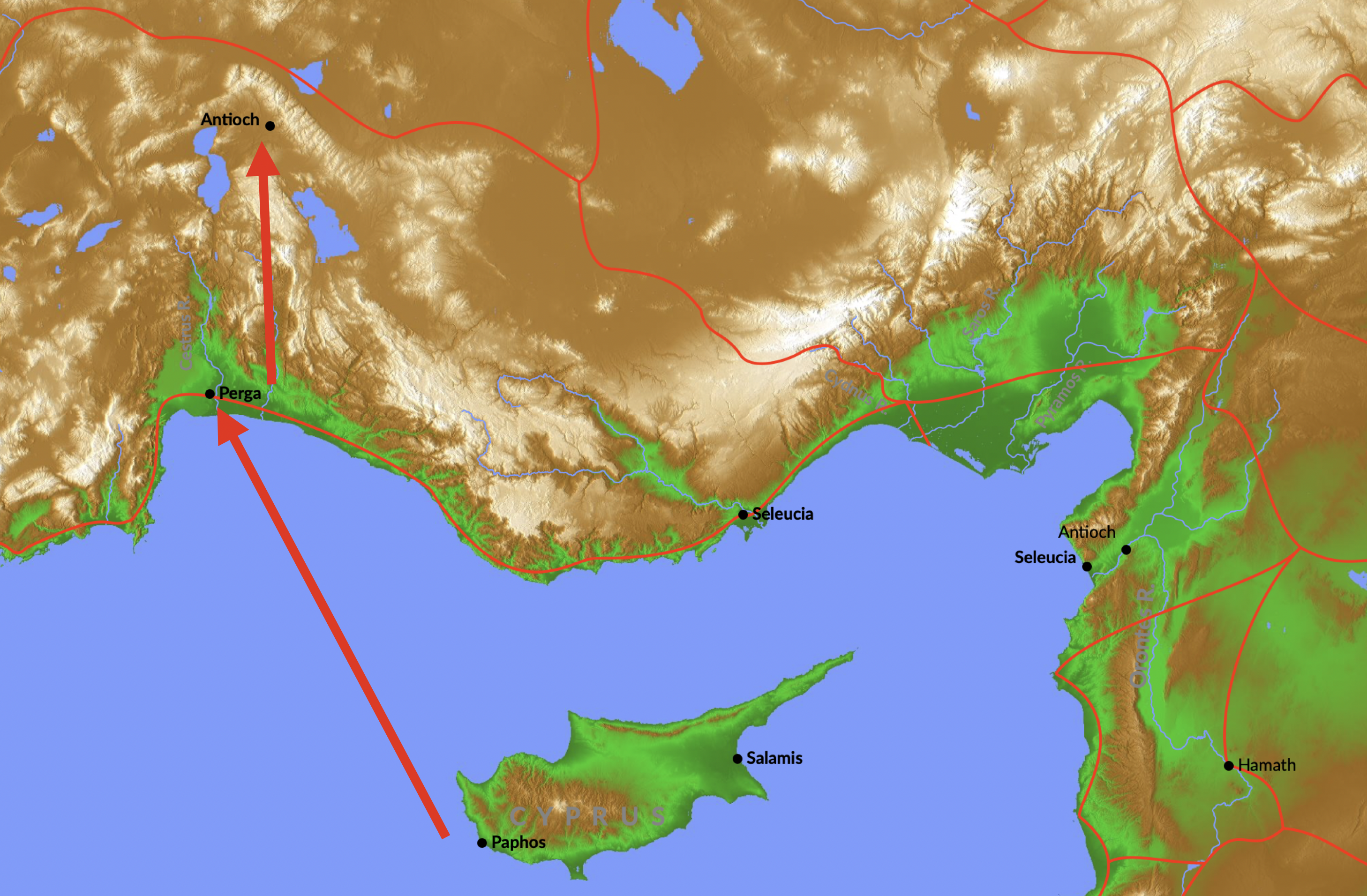
    We are back in the city of Antioch today, and you will recall that Antioch was the third-largest city in the Roman Empire, about the size of Atlanta today.  It was the place where Jews and Gentiles really began to worship together, following Messiah Jesus.  Barnabus was sent there from Jerusalem to find out what was going on with the Gentiles, and he brought Saul there, and the two of them spent a year teaching “great numbers” of followers of Jesus. (Acts 11:25).   Our scripture today tells of a particular worship service they held there:

    Acts 13:1-3   Now in the church at Antioch there were prophets and teachers: Barnabas, Simeon called Niger, Lucius of Cyrene, Manaen (who had been brought up with Herod the tetrarch), and Saul. While they were worshiping the Lord and fasting, the Holy Spirit said, “Set apart for me Barnabas and Saul for the work to which I have called them.” So after they had fasted and prayed, they placed their hands on them and sent them off.

    Simeon called Niger.  Simeon is from the Hebrew name Shimon, the same as Simon Peter, so he was Jewish. Niger is a Latin word meaning ‘black’ or ‘dark,’ and it was used in a descriptive, not a derogatory fashion.  It is tempting to associate him with Simon of Cyrene, who was made to carry Jesus’ cross on the way to the place of execution (Luke 23:26), and that is possible.  Cyrene was on the Northern coast of Africa (modern-day Libya).  And he is mentioned with Lucius of Cyrene.

    But Shimon was a very common name for Jews.  There are 9 Simons in the New Testament, and two in Jesus 12 disciples (Simon Peter and Simon the Zealot).   Lucius was also a very common name for Romans.  In fact, Lucius was one of the standard 18 given names for Romans 

    Yes, almost all Roman men at this time were given one of these 18 names.  (Later expanded to 36 names.) 

    Aulus Lūcius Quintus
    Appius. Mārcus Servius
    Gāius Mānius Sextus
    Gnaeus Māmercus Spurius
    Decimus Numerius Titus
    Kaesō Pūblius Tiberius

    Romans typically had three names, such as Gaius Julius Caesar (given name, family name, and a specific branch of the family name or honorific).  Daughters were given the feminine form of their father’s name.  So the daughter of Gaius Julius Caesar was named Julia.  If there were more than one daughter, they added tags like Maior (the elder) or Minor (the younger).

    The other prophet and teacher mentioned in our passage this morning is Manaen.  All we are told of Manaen is that he had “been brought up with Herod the tetrarch.”  Your Bible probably has this in parentheses, and you are likely to read right past it.  The Greek phrase being translated here is often translated as “foster brother” and refers to boys of the same age as royal princes, who were taken to court as babies or very young children to be brought up with them.  So Manean was brought up with Herod the tetrarch, as if they were brothers.  Here we go with the Herods again.

    Herod the tetrarch we are talking about today is not Herod Agrippa that we discussed two weeks ago, the ruler with the shiny silver robes who accepted praise as a god and was struck dead.  That Herod was a grandson of Herod the not-so-Great.  Today we are talking about Herod Antipas, who was a son of Herod the not-so-great.  He would have been an uncle to Agrippa. 

    When Herod the not-so-great died, Herod Antipas took over 1/4 of his father’s kingdom and ruled Galilee and Perea from 4 BC to 39 AD.  We remember him as the one that John the Baptist called out for marrying his brother’s wife, Herodias.   (This Herodias was the sister of Herod Agrippa.).   Herod Antipas had John imprisoned and then had his head chopped off as requested by Salome, who, by the way, was the half-sister of the shiny-robed Herod Agrippa. And you thought TV soap opera families were mixed up.  As ruler of Galilee, Herod Antipas had some interaction with Jesus.

    Matthew 14:1-2   At that time Herod the tetrarch heard about the fame of Jesus, and he said to his servants, “This is John the Baptist. He has been raised from the dead; that is why these miraculous powers are at work in him.”

    Antipas was afraid that the man he had murdered, just to satisfy his wife, Herodias, and Salome, was back from the dead. So what does Antipas decide to do? 

    Luke 13:31-32   At that very hour some Pharisees came and said to him [Jesus], “Get away from here, for Herod wants to kill you.” And he said to them, “Go and tell that fox….

    And Antipas finally gets the opportunity to meet Jesus on the morning of his crucifixion.  When Pilate questions Jesus, he learns that Jesus is from Galilee, so he sends him to Antipas, the ruler of Galilee.

    Luke 23:6-11  When Pilate heard this, he asked whether the man was a Galilean. And when he learned that he belonged to Herod’s jurisdiction, he sent him over to Herod, who was himself in Jerusalem at that time. When Herod saw Jesus, he was very glad, for he had long desired to see him, because he had heard about him, and he was hoping to see some sign done by him. So he questioned him at some length, but he made no answer. The chief priests and the scribes stood by, vehemently accusing him. And Herod with his soldiers treated him with contempt and mocked him. Then, arraying him in splendid clothing, he sent him back to Pilate.

    Antipas basically gave his stamp of disapproval on Jesus to Pilate.  This was just what Antipas wanted.  Pilate could do what he could not do: kill Jesus publicly.  

    In the last years of his reign, Antipas was at war with the king of Arabia, primarily because he had divorced the daughter of the king of Nabatea to marry Herodias.  He lost that war and was then accused of rebellion against Rome by his nephew/brother-in-law, Herod Agrippa.  So Antipas was stripped of all of his money and land and exiled to Gaul (modern-day France).  

    Now, if you think we have spent a lot of time talking about all of these Herods, then you are correct.  But we keep finding them woven into the story of the Bible.  They are part of the context of this book, and if we don’t understand the political climate, then we miss part of what the original readers got from the scripture.

    Now that I have reminded you of how evil the Herods were, especially Herod Antipas, let’s look back at this man, Manaen.  He grew up with Antipas; they played together as children.  They were exposed to the same family, the same education, and the same religion.  The person Manaen knew as father was Herod the (not-so) great. And remember that Herod the not-so-great killed 3 of his sons, who were also Manaen’s foster brothers.  Imagine growing up with this crazed, murderous ruler as your father, and your closest friend being another evil despot, Herod Antipas. Not the best start

    And yet Luke tells us that this Manaen is a prophet and teacher in Antioch and helped launch the missionary movement that carried the gospel to the Gentile world. 

    Two boys raised in the same environment. One becomes part of a kingdom built on pride, power, and compromise.  The other joins a kingdom based on sacrifice, grace, love, and mercy.  Acts 13 quietly reminds us of a profound truth:  Your environment may have some influence on you, but it does not determine your destiny.  Your choices make the biggest difference.

    We see this over and over in the Bible and in our lives.  In Genesis 4, we have Cain and Abel.  They were raised by a mother and father who walked in the garden with God.  They heard firsthand of God’s love and grace, but also of His judgment.  These brothers both brought offerings to God.  Abel’s offering was accepted. Cain’s offering was not accepted. 

    Genesis 4:2-5  Now Abel was a keeper of sheep, and Cain a worker of the ground. In the course of time, Cain brought to Yehovah an offering of the fruit of the ground, and Abel also brought of the firstborn of his flock and of their fat portions. And Yehovah had regard for Abel and his offering, but for Cain and his offering he had no regard.

    You have probably heard that Abel’s offering was accepted because it was a choice animal sacrifice, and Cain’s was rejected because it was not.  But if you have read Leviticus, you know that grain and other harvested crops are certainly acceptable sacrifices.   The problem was not Cain’s offering, but it was Cain’s heart.  

    Genesis 4:6-7   Yehovah said to Cain, “Why are you angry, and why has your face fallen? If you do well, will you not be accepted?

    God does not say “will your offering not be accepted” but “will you not be accepted.”  Again the problem is Cain, not the offering.  Remember what Jesus said:

    Matthew 5:23-24  So if you are offering your gift at the altar and there remember that your brother has something against you, leave your gift there before the altar and go. First be reconciled to your brother, and then come and offer your gift.

    Jesus spoke these words as if he were speaking to Cain’s situation.  God is much more concerned with the heart of the one offering than He is with the gift itself.  

    And Cain then kills his brother Abel.  And I can not for a minute believe that this one instance of jealousy led to murder.  Resentment had been building up inside of Cain for some time, and Genesis merely tells us the straw that broke the camel’s back.  And it is in this state of resentment of his brother that Cain makes an offering that God can not accept.

    Genesis 4:6-7   The LORD said to Cain, “Why are you angry, and why has your face fallen? If you do well, will you not be accepted? And if you do not do well, sin is crouching at the door. Its desire is contrary to you, but you must rule over it.”

    God makes it clear to Cain.  Cain was not trapped by fate. He was confronted with a choice.  Do well and be accepted, or do not do well and be conquered by sin.  And this is the difference between Cain and Abel.  They were raised the same, but they made different choices.  Abel is remembered as a man of faith. Cain is remembered as a man who fell prey to sin.

    Another example is Jacob and Esau.  Twin brothers. Same parents. Same household. Same God.  Yet Esau treated spiritual things casually. He sold his birthright for a bowl of stew.  He shunned his parents’ advice to be obedient and not take a wife from the Hittites.  The book of Hebrews later describes Esau as someone who was “sexually immoral” and  “unholy” because he traded eternal things for immediate gratification.  Jacob certainly was not perfect.  He had flaws and failures, but he desired God’s blessings and promises.  One brother lived for the moment. The other eventually learned to pursue God.  Again, similar upbringing, different decisions, different priorities.

    And I could talk of other brothers in the Bible who were raised in the same family but had different outcomes.  We could speak of Joseph and his brothers and the difference in their lives due to the decisions they made.  Or we could talk of the brothers in Jesus’ story of the prodigal son. But look at the deep contrast here in Acts of Manaen and Herod Antipas.

    Herod Antipas sought to gain authority through harsh rule and murder.
    Manaen surrendered himself to the authority of God.

    Antipas imprisoned and killed a prophet.
    Manaen became a prophet and teacher.

    Herod Antipas scorned and mocked Jesus.
    Manaen chose to follow and worship Jesus.

    Antipas tried to shut down the spread of the Gospel.
    Manaen participated in sending the gospel to the nations.

    This is one of the best contrasts of life choices in Scripture.

    Antipas and Manaen both learned from Herod the (not-so) Great. Antipas became just like Herod, leading a kingdom through treachery, deceit, and murder.   Manaen chose to go the opposite direction, joining the kingdom of God, in opposition to the kingdoms of this world.   Regardless of what kind of environment you grow up in, you choose your own path.  And, like Antipas and Manaen, it seems that children either follow their parents’ path or take a completely opposite path.

    It is like the story of a man who was a violent drunk who beat his two sons every day. There was never a day he wasn’t drinking.  The first son went on to be a violent drunk like his father; the second never touched alcohol and avoided all forms of violence.   When asked why they became who they were, both of the sons said, “With a father like that, how could I not end up like this?”   We cannot choose our circumstances, but we can choose how we react to them.

    And we could talk of modern-day examples.  Adolf Hitler grew up in a home with a strict, physically abusive father.  His father died when he was 14, and his mother 4 years later.  This difficult childhood definitely influences a person, but it does not determine their destiny.  His sister Paula grew up in the same household but lived a quiet life, never joining the Nazi Party.   Or we could talk about Malcolm X and his siblings, or Jimmy Carter and his brother, or many more.

    Everyone must choose which kingdom they will serve.  Moses said it this way:

    Deuteronomy 30:19-20  I call heaven and earth to witness against you today, that I have set before you life and death, blessing and curse. Therefore choose life, that you and your offspring may live, loving Yehovah your God, obeying his voice and holding fast to him, for he is your life and length of days, that you may dwell in the land that Yehovah swore to your fathers, to Abraham, to Isaac, and to Jacob, to give them.

    Joshua said this: 

    Joshua 24:15 …choose this day whom you will serve … But as for me and my house, we will serve Yehovah.

    In his poem The Road Not Taken, Robert Frost said this:

    Two roads diverged in a wood, and I—
    I took the one less traveled by,
    And that has made all the difference.

    And Jesus, in the Sermon on the Mount, said:

    Matthew 6:24   No one can serve two masters…

    Every person must choose what kingdom they will serve.  Herod chose an earthly kingdom of fame and fortune, murder and deceit.  Manaen chose the Kingdom of God.  And all of us today are who we are based on the choices we have made.  

    But I want to focus for just a few minutes on something that we don’t know about Herod Antipas and Manaen.   We know of the negative influence of Herod and his family on Manaen.  But for Manaen to become a prophet and teacher in one of the world’s largest Christian communities, there had to be someone who was a major positive influence on him.   Someone had to show him the possibility of a path different than the path of the Herods.  There is someone not mentioned here who spoke life into Manean.  Someone who told him about Jesus.  Someone who invested time in him. 

    Now I have a theory about who it could have been.  Luke mentions Joanna in Chapter 8 of his gospel as a woman Jesus healed of evil spirits.  She was the wife of Chuza, the head of Herod Antipas’ household.  Joanna was a disciple of Jesus and supported his ministry financially. She is present at Jesus’ tomb with Mary Magdalene and other women.  And her place in the household of Manaen’s foster brother means she would certainly have known Manaen.  It could have been her who led Manaen to Jesus and helped him choose not to follow the way of the Herods.  

    Think for a moment about the people outside your immediate family who had a strong positive influence on you.  Who showed that they believed in you at a time when you needed it?  Who was there for you? 

    We need to share our stories.  I want to encourage you to share with someone this week the story of the person who influenced you.  If they are still around, you might give them a call or send them a note.  But I am asking you to tell someone else the story, over lunch today or sometime this week.  This story of Manaen and Herod is in our Bibles for a purpose.  This story needs to be told, and your story needs to be told.

    Secondly, I want you to ask God to direct you to at least one person that you can pour into over the next few years.  Someone that you can be intentional to build up, to encourage, to pray for. Someone that you will reach out to weekly.  It may be a young person, or it could be someone of any age.  Everyone needs someone to believe in them and lift them up.  

    I want to encourage you to commit to “Go Deep” with someone.   Most of our relationships are way too shallow.  We have so many people that we talk with, but we never seem to talk about the really important things in life.  Consider committing to long-term impact with one or a few people.  To have regular contact with them.  You can’t pour into a lot of people this way, but you can make a difference for a few.  Andy Stanley says it this way, “Do for one what you wish you could do for everyone.” 

    Be intentional!  Choose someone who is unchurched, or someone who really needs a friend or someone to cheer for them.  Look at this story in scripture.  Someone spoke life into this man, Manaen, and instead of following the way of the Herods, he chose to follow the path of Jesus.  He did not become like his father, Herod the not-so-great, or his brother Herod Antipas. Instead, he strove to become more like his Heavenly Father.  And by being a part of the group that sent out the first missionaries, he changed the world.  And someone unknown to anyone today except God helped make that difference in Manaen’s life.

  • May 20, 2026 – Who Is on the Throne Now? — Acts #41
    Acts. 12:6-17

    This week, we come to the end of the story of Peter’s miraculous escape from prison and the end of Herod Agrippa. Remember, Agrippa had come to power through his friendship with Caligula, one of Rome’s most immoral emperors.  And to gain favor with the religious elite in Jerusalem, he killed James and then put Peter in prison until he could have him publicly executed also.  

    And several weeks ago, we looked at the evil of Agrippa and asked ourselves whether it is ever possible to forgive someone so evil.  And looking at scripture, we concluded that for us, forgiveness is not an option. We are called to imitate Jesus, who from the cross pleaded for forgiveness for those who were torturing him.  We must be people who show grace and forgiveness just as God has shown grace and forgiveness to us. 

    Then we looked at the type of prayer that the people were praying for Peter.  The word used to describe their prayer, the Greek ektenos, is only used for prayer one other time in the Bible.  They were praying as Jesus did in the garden, praying with every ounce of energy and strength they had.  That is how we should pray.

    Then last week, we looked at Peter’s miraculous escape and miracles, and how God is still doing miracles all around us today.  God is still answering prayer and intervening in our world.  He is still making the blind to see, the lame to walk, and the deaf to hear.  He is still healing people before our eyes.  And I urge you to read one of the books I mentioned so you can see for yourself how God is still working today.  

    This week we come to the end of the story of Peter’s miraculous escape from prison. And there is one more lesson to learn here.  And it is about the greatest sin.  

    So to finish the story, Peter escapes and goes to the house church at John Mark’s house.  When he finally gets them to open the door,  Peter quickly tells the house church of his escape, and then Luke tells us:

    Acts 12:17   Then he departed and went to another place.

    We will not see Peter again until Acts 15.  We have no idea where he went after this. That is not what Luke sees as important here.  Luke doesn’t think it is so important that we know what happened to the apostle Peter, but he thinks it is very important that we know what happened to the evil king, Herod Agrippa.  Sometimes it is very interesting to pay attention to what is not included in the Bible.  So let’s discover why this part of the story is so important to Luke.

    Acts 12:18-19   Now when day came, there was no little disturbance among the soldiers over what had become of Peter. And after Herod searched for him and did not find him, he examined the sentries and ordered that they should be put to death. Then he went down from Judea to Caesarea and spent time there.

    Agrippa is very displeased that his prized prisoner escaped.  He was ready to have another public beheading.  Luke says there was “no little disturbance.” That is his way of saying that Herod went to look for Peter himself and he went ballistic.  The usual punishment for a soldier who let a prisoner escape was to be given the punishment the prisoner was due.  And Agrippa sure isn’t going to miss a chance to kill another person.  So he has the soldiers put to death. Then Herod leaves Jerusalem to head back to his coastal palace in Caesarea.  Let’s keep reading…

    Acts 12:20  Now Herod was angry with the people of Tyre and Sidon, and they came to him with one accord, and having persuaded Blastus, the king’s chamberlain, they asked for peace, because their country depended on the king’s country for food.

    Apparently, the people of Tyre and Sidon had done something to upset Agrippa, and he was withholding food exports from them.  ‘You made me angry; then you and your people can starve.’  There is no end to the evil of this man.  I’m sure there were lots of people living then who prayed that God would strike Herod dead.  And God did.  But what was the sin that led God to put an end to Agrippa finally?  That is the story that Luke finds important enough to tell.

    Acts 12:21-22   On an appointed day Herod put on his royal robes, took his seat upon the throne, and delivered an oration to them. And the people were shouting, “The voice of a god, and not of a man!”

    This is another time when historians of the day corroborate the Bible’s story and even give us additional details.    Let’s read what the historian Josephus says about this event, from his book Antiquities of the Jews:  

    “At Caesarea, Agrippa exhibited shows in honor of Caesar, knowing that this was celebrated as a festival for his welfare. There came together for this occasion a large number of provincial officials and others of distinguished position. On the second day of the shows, Agrippa put on a robe made of silver throughout, of quite wonderful weaving, and entered the theatre at break of day. Then the silver shone and glittered wonderfully as the sun’s first rays fell on it, and its resplendence inspired a sort of fear and trembling in those who gazed at it.   (Josephus  “Antiquities of the Jews” 19:343-50)

    The New International Commentary on the New Testament tells us that the “appointed day” on which the people of Tyre and Sidon were to be publicly reconciled with Agrippa was a festival celebrated every 5 years on March 5 in honor of the founding of Caesarea.  Josephus tells us Agrippa comes out to the celebration at the break of day wearing a robe made of silver.  Now I have seen sequinned dresses and my friend Tim has several sequinned jackets, but I have never seen a robe made of silver.   

    And it is in this theater in Caesarea Maritima, originally built by Agrippa’s just-as-evil grandfather, Herod the not-so-great.  It is in a beautiful setting right on the shores of the Mediterranean Sea and would hold about 4,000 people.  It has been refurbished and is still used today for concerts, recently by Foreigner, Alanis Morissette, and Eric Clapton.

    But on this day, in 44 AD, the attraction was Herod Agrippa himself.  This theater faces the West.  So Agrippa comes out in his silver robe out front for everyone to see.  And Josephus tells us it was the break of the day.  So I am sure he arranged it so that he came out just as the sun rose behind the backs of those seated, and it hit that silver robe, making Herod shine like the sun. Let’s go back to Josephus’ account again:  

    “Then the silver shone and glittered wonderfully as the sun’s first rays fell on it, and its resplendence inspired a sort of fear and trembling in those who gazed at it. Immediately his flatterers called out from various directions, in language which boded him no good, for they invoked him as a god: ‘Be gracious to us!’ they cried. ‘Hitherto we have reverenced you as a human being, but henceforth we confess you to be of more than mortal nature.’ He did not rebuke them, nor did he repudiate their impious flattery.
    At the same time he was seized with a severe pain in his bowels, which quickly increased in intensity.… He was hastily carried into the palace, and … when he had suffered continuously for five days from the pain in his belly, he died, in the fifty-fourth year of his life and the seventh year of his kingship.”  (Josephus  “Antiquities of the Jews” 19:346-50)

    This meshes well with Luke’s telling of the same story in Acts:

    Acts 12:21-23  “On an appointed day Herod put on his royal robes, took his seat upon the throne, and delivered an oration to them. And the people were shouting, “The voice of a god, and not of a man!” Immediately, an angel of the Lord struck him down, because he did not give God the glory, and he was eaten by worms and breathed his last.”

    “Eaten by worms” is a common way ancient writers described the death of people worthy of such an end.   The historian Josephus describes his sudden attack of pain and hints that God caused it, but he doesn’t come out and say it. Luke is very clear.  An angel of the lord struck him immediately, and then he soon died.

    This passage is not merely a historical account of a ruler’s death. It is a warning about one of humanity’s oldest sins.  So what exactly is Herod’s sin?  

    At first glance, Herod’s sin appears to be ordinary pride. He accepted the crowd’s praise when they called him a god. He enjoyed their worshipful flattery rather than correcting them. But he is breaking the very first commandment given to Israel at Mt Sinai and the one that Jesus said was the greatest commandment. 

    Exodus 20:3  You shall have no other gods before me.

    This is the first of the 10 commandments.  The second is closely related.

    Exodus 20:4-5  You shall not make for yourself a carved image, or any likeness of anything that is in heaven above, or that is in the earth beneath, or that is in the water under the earth. You shall not bow down to them or serve them…

    In fact, some theologians group these two as one, the first of the 10 commandments.   Because making an idol, a representation of something you might worship, is putting another god in place of Yehovah.  But what does Jesus say?   Remember when he was asked what the greatest commandment was….

    Mark 12:28-30   “Which commandment is the most important of all?” Jesus answered, “The most important is, ‘Hear, O Israel: The Lord our God, the Lord is one. And you shall love the Lord your God with all your heart and with all your soul and with all your mind and with all your strength.’

    Jesus is quoting from Deuteronomy 6:4,5, a prayer that Jesus, his disciples, and every other practicing Jew for hundreds of years before Jesus and every practicing Jew today would say 2-3 times daily.  The Shema, the first prayer a child would learn and, traditionally, the last words spoken before death.  According to Jesus and the entire Jewish nation, these are very important words.  

    This question and response are also found in Matthew and Luke, but Mark is the only one of the three gospel writers to include the first phrase of the Shema.  And it is very important.  When we see in Mark Jesus say, “The Lord is one,” he is quoting the verse that says.

    Deuteronomy 6:4   Hear, O Israel! Yehovah is our God, Yehovah alone.

    There is only one God, and God is god alone.   This is #1 in the commandments, the first and the greatest. You see how the first phrase of the Shema, the first part of what Jesus said was the greatest commandment, is a restatement of the first of the 10 Commandments.

    We often focus on the first 2 commandments as idolatry, and think of it only as worshipping an idol, some representation of a god carved in wood or metal.  But bowing down before a carved idol may not be a huge temptation for us today.  We don’t have stores downtown selling images of gods that you can take home and worship.  (As far as I know.)  And nothing like this is in this story of Agrippa, but he is breaking these first two commandments here.  We are very much like Agrippa, for you don’t see our greatest temptation to worship an idol sitting on a shelf.  To see the subject of our idolatry and Agrippa’s idolatry, don’t look in a foreign temple, but look in a mirror.

    Herod’s idol was himself.  Our greatest temptation is to idolize ourselves.  Now, before you think, “Oh, that’s not me, I see all my faults, I see all my flaws.”  Just bear with me a bit.  Anything that takes God’s rightful place as ruler and object of worship becomes a god, an idol. This is the essence of idolatry: putting self where only God belongs.  And this is the oldest sin in the book.

    In Genesis chapter 3, the serpent tempted humanity with these words: “You will be like God”, “you can discern good and evil for yourself”, “you can make your own rules.”  The appeal was not simply knowledge or power.  It was autonomy—the desire to define good and evil for ourselves, to rule ourselves rather than live under God’s rule.  This is the root of all sin.  Every time a person says:

    “I will decide what is right for me.”
    “No one tells me how to live.”
    “I will do whatever I want to do.”
    These are all repetitions of the rebellion of Eden.

    Herod embodied this spirit publicly. He enthroned himself not only politically, but spiritually.

    He was the king over his land.  He made all the rules.  If he wanted to kill some Christians, he did.  If he wanted to withhold food from the people of Tyre and Sidon and let them starve, he did.   And he was convinced that he alone would decide if these things were right or wrong.

    And this attitude of self-worship naturally leads to a change in the way you treat other people.   Once you see yourself this way, you begin to treat other people differently, for they are less than you.  That is why when Jesus was asked what the greatest commandment was, Jesus answered not with one but with two commands because they are inseparable.  When God is displaced, self takes the throne, and everyone else becomes a servant, a rival, or an obstacle.  Pride always climbs by stepping on others.

    And God said that is no way to do life.  All the rules God gives are to lead us to live better, more productive, good lives.  From the beginning in the garden:  God says, ” Enjoy all these trees, but watch out for that one; it will kill you.”  His torah, his instruction, is to guide us in the correct way to live.  And as our creator and sustainer, he knows best.  If we could only follow what Jesus said were the two greatest commandments, then all of our lives would be so much richer and better.  And while Herod Agrippa, with his shiny silver robes and people proclaiming him as God, is an extreme example, we have to admit to ourselves that we are tempted to put ourselves first.   How do you make your decisions?  Do you consult God or do you decide for yourself?  Do you ask God what is best, or do you use your best judgment?  Agrippa accepted this divine honor from the people on that day because he had already enthroned himself in his heart.

    You will probably never sit on a literal throne like Herod.  But every heart has a throne.  The question is simple:  Who sits on your throne?  When you come to commit to Jesus, you promise God that you will turn over control of your life to Jesus and that you will no longer decide for yourself what is right and wrong.  Anytime we ignore Jesus and make our own decisions, we are rebelling against god and setting ourselves up as our own god, taking his place.

    But learn the lesson from this story of Herod Agrippa:  self-rule, self-importance, and self-worship are all just illusions.  Herod looked powerful.  He wore shiny royal robes. He sat on a throne. Crowds praised him as divine.  Yet Luke shows how fragile that illusion was.

    Acts 12:23  “Immediately an angel of the Lord struck him down, because he did not give God the glory, and he was eaten by worms and breathed his last.”

    The man who appeared godlike, all-powerful, was reduced to dust and decay.  This is the lie of self-rule: it promises control, but we are never truly sovereign.  We cannot rule over our own mortality.  We can not control our circumstances.  We are not sovereign over our final destiny.  We cannot even guarantee our next breath.  Herod imagined himself above accountability. In reality, he was accountable every second to the God he ignored.  The same is true for all of us.

    Look at the striking contrast between Herod’s end and the last verse of the passage:

    Acts 12:24   But the word of God increased and multiplied.

    Herod’s life comes to a bitter end.  But the word of God flourishes.  Earthly rulers rise and fall, but God’s kingdom advances.  God opposes the proud but exalts the humble.  Herod sought glory for himself and lost everything.  Jesus, by contrast, humbled Himself to death on a cross and was exalted above every name.

    So the question for us today is the same question Adam and Eve had to answer: “Who rules your life?”  Who sits on the throne of your heart?  Who decides right and wrong in your life?  Who makes the decisions?  Who is the leader and who is the follower?  The great temptation to forget or ignore God in everyday life is the temptation to idolatry, putting someone else in God’s place.  

    If we insist on ruling ourselves—defining truth, pursuing our will as ultimate, living for our own glory—we commit the same essential sin as Herod.  We make ourselves god.  The first commandment calls us to tear down that idol and return the throne to its rightful King. True freedom is not found in self-rule.    It is found in joyful surrender to the rule of God.

  • May 13, 2026 – Open Your Door to a Miracle — Acts #40
    Acts. 12:6-17

    So last week, we continued the story in Acts 12 of Peter’s miraculous release from prison.  It was the night before Peter was to be put to death by Herod Agrippa.  Luke tells us that the followers of Jesus were together that night, praying earnestly for Peter.  And we discussed what Luke meant by this type of prayer.  The adjective he used for this prayer was ektenos, the same word he used for the prayer Jesus prayed in the garden.  This is intense, fierce, giving it 100% prayer.  God sent an angel to escort Peter from his cell.  Let’s review the scripture and continue the story.

    Acts 12:6-17  “Now when Herod was about to bring him out, on that very night, Peter was sleeping between two soldiers, bound with two chains, and sentries before the door were guarding the prison. And behold, an angel of the Lord stood next to him, and a light shone in the cell. He struck Peter on the side and woke him, saying, “Get up quickly.” And the chains fell off his hands. And the angel said to him, “Dress yourself and put on your sandals.” And he did so. And he said to him, “Wrap your cloak around you and follow me.”
    And he went out and followed him. He did not know that what was being done by the angel was real, but thought he was seeing a vision.   When they had passed the first and the second guard, they came to the iron gate leading into the city. It opened for them of its own accord, and they went out and went along one street, and immediately the angel left him. When Peter came to himself, he said, “Now I am sure that the Lord has sent his angel and rescued me from the hand of Herod and from all that the Jewish people were expecting.
    “When he realized this, he went to the house of Mary, the mother of John whose other name was Mark, where many were gathered together and were praying. And when he knocked at the door of the gateway, a servant girl named Rhoda came to answer. Recognizing Peter’s voice, in her joy, she did not open the gate but ran in and reported that Peter was standing at the gate. They said to her, “You are out of your mind.”
    But she kept insisting that it was so, and they kept saying, “It is his angel!” But Peter continued knocking, and when they opened, they saw him and were amazed. But motioning to them with his hand to be silent, he described to them how the Lord had brought him out of the prison. And he said, “Tell these things to James and to the brothers.” Then he departed and went to another place.

    When Peter realizes this is not a dream or vision, he first goes to let the other Jesus followers know that he has been miraculously freed.  Remember that, at this point, there are no “church” buildings for the Jesus followers, so they are meeting in various homes.   Peter goes to the house church that meets at the home of Mary, the mother of John Mark. (You will hear a lot more about John Mark, the author of the gospel of Mark, as we continue through Acts.)  John Mark’s father is likely deceased, for it is recorded as Mary’s home.  And it is described as a large home with a courtyard and exterior gatehouse.  

    Peter knocks on the outer door.  The servant girl, Rhoda, comes to the door but does not open it.  “Who is it? ” she asks.  “Please let me in,” Peter responds.  Now look at what Luke tells us happens next:

    Acts 12:14   Recognizing Peter’s voice, in her joy, she did not open the gate but ran in and reported that Peter was standing at the gate.

    So Peter is left standing in the street.  Remember, he has just escaped from prison, likely in the Antonia Fortress, where hundreds of Roman soldiers are garrisoned.  He is a fugitive, and he would really like not to be standing out in the open on an empty street right now.  Especially at the house where the Jesus followers meet, which would be the first place the authorities would look for him.  

    And Rhoda leaves him outside to report to the crowd praying for Peter that Peter is at the doorway.  Luke says, “in her joy,” she did not open the gate.   I get it.  She was so overjoyed that Peter is there that her brain stops communicating with her body.  Often when people are overjoyed, they don’t act logically.  (Proof of this is watching any contestant who wins on The Price Is Right.)

    While Peter is waiting outside trying not to look like an escaped criminal, Rhoda interrupts the prayer meeting to tell them that Peter is at the door.  And they all shout out, “Yay! Of course he is; that is exactly what we were praying for!  God has answered our prayers.  Praise Jesus!” Well, no.  Instead, they say this:

    Acts 12:15   They said to her, “You are out of your mind.”

    The Greek word Luke uses, which the ESV translated as ‘out of your mind,’ is  μαίνομαι   mainomai, where we get our word ‘manic’ or ‘maniac.’  They don’t believe her.  Peter couldn’t possibly be here; he is in prison.

    There was a Jewish thought in the day that each person had a guardian angel, and a person’s angel resembled them in appearance.   Is there any scriptural evidence for this?  Or is this just a superstition of the time?   Let’s look at a few other passages that suggest this. 

    Matthew 18:10   “See that you do not despise one of these little ones. For I tell you that in heaven their angels always see the face of my Father who is in heaven.”

    Psalm 91:11-12   For he will command his angels concerning you to guard you in all your ways.  On their hands they will bear you up, lest you strike your foot against a stone.

    Psalm 91 is addressed to “all who have chosen to ‘live in the shelter of the Most High,’ a Psalm for every true follower of God.   We know it as a verse quoted by the satan to Jesus when he was tempted.  It is for all of us on this earth, and how much more for God’s only son?   Angels are watching over us.   I have often said we have no idea how many disasters we avoid due to divine intervention. So I think there is clear scriptural evidence that God uses angels to protect us.  But an individual guardian angel?  That is not as clear from scripture.  

    I have met one person whom I believe God gave the gift of seeing the heavenly beings.  And he believed that we all had our own angel assigned to us, as well as other angels when we needed them.   He always saw the same angel around my wife, sometimes with other angels also.  So do we all have our own angel?  He thought so, and he saw a lot more angels than I have seen.

    Meanwhile, we have still left Peter in the street, knocking on the door, hoping it is loud enough for the people inside to hear but not so loud as to wake the neighbors.

    Acts 12:16-17   But Peter continued knocking, and when they opened, they saw him and were amazed. But motioning to them with his hand to be silent, he described to them how the Lord had brought him out of the prison. And he said, “Tell these things to James and to the brothers.” Then he departed and went to another place.

    So they open the door and see Peter, and they are all celebrating and shouting, and Peter is motioning for them to be quiet.  (And I am sure Peter is thinking that these people have clearly never been part of a prison break before.)  This is a great story that Luke included in his book.  It has drama, suspense, humor, and a miracle.  And last week, we concentrated on the type of prayer that Luke said the people had gathered to pray for Peter.  This week I want to consider the idea of the miracle.

    So, what is your experience with miracles?  Some denominations believe that God stopped performing miracles after the time of the Bible.  They are called “Cessationists”, saying that miracles like healing, prophecy, and other spiritual gifts ceased after the time of the apostles and the completion of the New Testament.  They say God is out of the miracle business now.

    Let me say that I find no suggestion in Scripture that God stopped doing God things after 90 AD.  Instead, I see promises that He will continue to intervene in our lives in mighty ways.  But even more, I can not deny what I have experienced myself.  I have told you of several of the miracles that I personally witnessed: of God supplying hundreds of doses of medicine for children in Guatemala from an empty bin.  Of rain that paused only in a circle over us in a meeting in Mexico. Of miraculous provision of a rare medical item that was needed in Ghana, found in a box of discarded medical supplies in a shipping container that arrived that week.  (The box had been thrown on the shipping container when it was sent 6 months earlier, only placed there because there was a little room left.)  I have taken care of a child with stage 4 cancer who was given no hope of recovery, and got a repeat MRI only to find his large tumors had suddenly disappeared with no medical treatment.  I have seen chronic diseases that should end life cured.  I have seen children on the brink of death recover completely overnight from nothing we did medically.  I saw my dad’s tumor on his face fade away and then watched his oncologist stand in shock, telling us that the medicine did not work that way.  

    I can tell you this morning that God is still God.  That He did not stop intervening in our world 2000 years ago.  That He is still working all things out for our good.  But some people will never be convinced.  

    How extraordinary must an event be to be called a miracle?  What does it take to convince someone of a miracle?  It depends on your worldview.  Those who trust God may see miracles in the small details of life, whereas people who do not believe in God may say that miracles are impossible.  The most extreme example of this is in the book of Exodus.  The Pharaoh of Egypt watched the Nile turn to blood; he saw plagues of frogs, flies, lice, boils, locusts, hail, and darkness descend on his country, striking fear into his people.  And then the death of the firstborn. All of this as announced by Moses.  But he still did not believe in the God of Moses or in his power.  He stood in his chariot and watched as a sea parted and his former slaves walked across on dry land.  But still, he did not believe.  Pharaoh, who thought himself a god, could never believe in miracles from the God of Israel.

    And how about the people who witnessed the resurrection of Lazarus?  Jesus made sure he didn’t arrive until Lazarus had been dead for 4 days.  He wasn’t just cold, but he was decaying.  You would think everyone there would have to believe that Jesus had performed a miracle and that he must be who he said he was.  But John, in his gospel, tells us this:

    John 11:45-46 “Many of the Jews therefore, who had come with Mary and had seen what he did, believed in him, but some of them went to the Pharisees and told them what Jesus had done.”

    Many were impressed, and they believed.  But others reported Jesus to the people who wanted to kill him.  Some people’s minds were made up, and they would never be convinced about Jesus and his works.  But look what Jesus says:

    Matthew 11:20   “Then he began to denounce the cities where most of his mighty works had been done, because they did not repent.”
    Luke 10:13-14   Woe to you, Chorazin! Woe to you, Bethsaida! For if the mighty works done in you had been done in Tyre and Sidon, they would have repented long ago, sitting in sackcloth and ashes. But it will be more bearable in the judgment for Tyre and Sidon than for you.”

    Those too hard-hearted to see God working miracles right before their eyes receive the stern rebuke of Jesus and the warning of coming judgment.

    The word our Bible uses for miracles is ‘signs’.  They were to be a sign that God is who He said He is, that He is powerful, that he is compassionate.  And there should only be one response to a display of God’s power.  It is the response of Isaiah when he witnesses God’s glory: to fall on his knees in repentance.

    And indeed, we still see this happening in our world.  Just 50 or 60 years ago in Nepal, there were no Christians.  And today there are over half a million.  And the head of Nepal Theological Seminary stated that over 80% of the Christian conversions in Nepal were due to healings or deliverance from spirits.   God is still using miracles as signs pointing to Himself, leading people to repentance and to His kingdom.

    I read that story about the miracles in Nepal in a great book entitled “Miracles Today” by Craig Keener, a well-respected theologian.  Keener received his PhD from Duke University, and he is currently a professor at Asbury Theological Seminary.  In this book, Keener reviews the theology of miracles, the scriptural evidence for them, and then documents hundreds of miracles he has personally investigated.  It is a condensed version of his original book on miracles, considered the most exhaustive on the subject.  That one, entitled “Miracles, The Credibility of the New Testament Accounts,” is almost 1300 pages.  

    Another good book on the subject is “The Case for Miracles” by Lee Strobel. Strobel is the journalist from the Chicago Tribune who was an atheist and, following his wife’s conversion to Christianity, set out to prove that Jesus wasn’t who he said he was.  As a result of his investigation, he became a Christian.  Strobel interviewed Craig Keener for his book and leans heavily on Keener’s theology and experience.

    Again, what is your experience with miracles?  Someone stated to me that miracles happened all the time in Jesus’ day, but rarely happen now.   While I agree that when God walked on the earth as Jesus, there were many miracles during his very short ministry.   But looking back on my life and reading Keener’s book, I cannot agree that miracles are rare today. Dramatic healings don’t happen every day in our town, but when you look at our nation or the whole world, miracles are happening daily.  This is one of the benefits of reading a book on miracles today.

    Let me tell you just one of the many stories from Keener’s book that is set in Suriname. Suriname is a multicultural nation in South America whose national language is Dutch. Suriname was not devoid of Christians, but in Nickerie, the northern coastal province of Suriname, it had another dominant faith [Hindu] and had resisted the Christian message for centuries. For generations, only a few hundred Christians lived there, and churches competed with each other for the same members.

    In his book, Craig Keener said, “I met with Dr. Douglass Norwood in 2006, and he shared with me his eyewitness experience from twelve years before, also recounted in his dissertation.  He was a Moravian pastor, and Moravians had been among the pioneers of churches there.

    In November 1994, after he preached, the churches there repented of their divisions and cried out to God for an outpouring of the Holy Spirit. Believers went out and began to share their faith with surprised neighbors, who had never known the Christians to act this way before.

    That night, many non-Christians gathered at the church—a few of them hostile. One hostile visitor, perhaps in his seventies, had been paralyzed on his right side virtually all his life. Because he could not walk, his friends had brought him on a blanket or rug and plopped him down on the ground in front of Norwood. This man was not happy. “Your religion is garbage!” he shouted. “My religion is garbage too! I’ve prayed to Shiva, and to Vishnu, and to my other gods, and nothing happens. Now you want me to pray to Jesus?”

    As he uttered the name Jesus, his paralyzed arm suddenly shot up into the air. He stared at his own arm, shocked. No one had prayed for him, but when he mentioned Jesus, God healed his paralysis. Norwood reports, “At that instant, he jumped up, grabbed my mike, and began screaming, ‘Look what Jesus did for me!’ as he danced around, waving his now-healed arm in the air.”

    The other visitors were converted almost as quickly as he was. This was the beginning of a movement that, over the next few years, brought tens of thousands of people to faith in Christ, most of whom had previously had little exposure to him. The massive growth of the Christian movement in Nickerie in recent decades is well known.”

    When John the Baptist sent his disciples to ask if Jesus really was the Messiah, the Son of God, this is what Jesus said.

    Matthew 11:4-6  “Go and tell John what you hear and see: the blind receive their sight and the lame walk, lepers are cleansed, and the deaf hear, and the dead are raised up, and the poor have good news preached to them. And blessed is the one who is not offended by me.”

    Let me tell you this morning that Jesus is still Jesus.  He is still the Son of God, and He is still our Messiah.  And He is still doing what he was sent to do.  He is up in heaven interceding for us with the Father even now.  He sent His Holy Spirit to dwell in us and among us.  And the Holy Spirit comes with power.  The power to heal, to resurrect, to calm storms and to provide all we need.

    Do not be offended by the idea of miracles.  Do not be like the villages that Jesus rebuked for their unbelief.   Because these followers of Jesus in Acts 12 did not believe Peter had been released from prison.  Let me remind you that this group of people has gathered while the rest of the city is sleeping to pray for God to intervene for their friend in prison.  And they are praying seriously.  Luke has told us that they were praying ‘ektenos’, the kind of fierce praying that Jesus did in the Garden of Gethsemane.  They are desperate for God to interrupt Herod’s evil plans for Peter.  And these are people of faith.  It has been just around 15 years since the resurrection.  Likely, some of these people had encountered Jesus after he was raised from the dead.  They have seen miracles with their own eyes.  

    So how could it be that they are unable to believe God has performed another one here this night?

    They remind me of a story I heard a preacher tell once about a farming community in a severe drought.  They called for a special prayer meeting at the church one night.  So they all gathered to pray for rain.  But only one little girl brought an umbrella.

    I think we have the same problem these followers in 45 AD had.  While they had witnessed a miracle or two or three, they also had seen many more times when miracles didn’t happen. They were in the city when Stephen was stoned.  God did not intervene then.  They saw their friends and family hauled off to be whipped and beaten. Some may have experienced this persecution themselves.  And they had just seen James, the brother of John, taken by Herod Agrippa and beheaded in public.   And there was no miraculous intervention by God. 

    And it seems that their personal experience of times without a miracle overshadowed the miracles they did see. 

    Is every prayer answered with a miracle?  No.  Jesus prayed hard in the garden for his cup of suffering to be taken from him, if possible.  His prayer was not answered just like he wanted.  Hundreds of people I know prayed long and hard for a little girl who was going blind.  She lost her vision.  While miracles aren’t as rare as you might think, they don’t happen all the time.  If they did, they wouldn’t be miracles, the extraordinary signs God uses to bring people to him.

    You see, one day God will bring about a full restoration of all the world’s wrongs.   One day God’s will will be done on earth as it is in heaven.  One day there will be no blindness, no lameness, no sickness, no cancer, no death.  One day, God will bring ultimate healing to all.  Until then, we have these occasional glimpses of glory as God heals, provides, and moves mountains here.  Miracles are just a foretaste of the full restoration of all the world’s wrongs that God will do one day.  Lazarus was raised from the dead, but years later he died again, and his body remained buried that time.  All those people Jesus healed eventually developed other health problems and didn’t recover.  All of the healings and miracles we see on this earth are temporary.   But one day we will all be healed forever.  

    Yes, John the Baptist, Jesus is the messiah who has come to make everything right. But everything in its own time.  The kingdom starts as a tiny seed before it grows into a mighty tree. 

    So what is our lesson from this story in Acts 12?  They have gathered to pray while others sleep, praying fiercely.  We need to pray like that. But when a miracle walks right up to their door, they don’t open it.  They are pleading with God to do something, but when He does, they are slow to see it.  

    Let me testify that God is doing miracles in our world, but many people’s minds are just as closed as that door in Peter’s face.  We miss so much of God’s goodness because we are so busy with the things of this world that we miss that miracle knocking on our door.   Do not miss the miracle.

  • May 5, 2026 – Praying for Peter in Prison — Acts #39
    Acts. 12:1-17

    Last week, we looked at the first five verses of Acts 12, and the Holy Spirit took us in a challenging direction.  I talked about Herod Agrippa and how he was from a family line of Herods that were evil and murderous.  Remember that Agrippa’s grandfather, Herod the not-so-great, killed his father, his grandmother, two of his uncles, and 4 other family members, not to mention scores of Jews and all the children under two years of age in Bethlehem.  And then Herod the not-so-great sent his grandson, Agrippa, off to Rome.  

    Agrippa returns and becomes ruler over the same land as his grandfather.  And he followed in his grandfather’s murderous footsteps, killing James, the brother of John, just to win favor with the Jewish Temple leadership.  He locked up Peter, intending to kill him next.  And the question we addressed last week is: How can we possibly forgive someone who commits such horrible murders? 

    And the answer we came to is that forgiveness is not optional, and we are to imitate our Heavenly Father, who has, out of his grace, forgiven us. And our ability to forgive such evil is a gift of grace from God through the power of the Holy Spirit available to us.

    Let’s review last week’s scripture and then continue the story:

    Acts 12:1-17   About that time, Herod the king laid violent hands on some who belonged to the church. He killed James, the brother of John, with the sword, and when he saw that it pleased the Jews, he proceeded to arrest Peter also. This was during the days of Unleavened Bread. And when he had seized him, he put him in prison, delivering him over to four squads of soldiers to guard him, intending after the Passover to bring him out to the people. So Peter was kept in prison, but earnest prayer for him was made to God by the church.
    Now, when Herod was about to bring him out, on that very night, Peter was sleeping between two soldiers, bound with two chains, and sentries before the door were guarding the prison. And behold, an angel of the Lord stood next to him, and a light shone in the cell. He struck Peter on the side and woke him, saying, “Get up quickly.” And the chains fell off his hands. And the angel said to him, “Dress yourself and put on your sandals.” And he did so. And he said to him, “Wrap your cloak around you and follow me.”
    And he went out and followed him. He did not know that what was being done by the angel was real, but thought he was seeing a vision.   When they had passed the first and the second guard, they came to the iron gate leading into the city. It opened for them of its own accord, and they went out and went along one street, and immediately the angel left him. When Peter came to himself, he said, “Now I am sure that the Lord has sent his angel and rescued me from the hand of Herod and from all that the Jewish people were expecting.”
    “When he realized this, he went to the house of Mary, the mother of John whose other name was Mark, where many were gathered together and were praying….

    There is more to this story, and we will continue it next week, but Today I want to focus on how the followers of Jesus responded to the arrest and expected murder of Peter.  Luke tells us in the beginning of the story that “earnest prayer for him was made to God by the church. (verse 5).   The Jesus followers in Jerusalem engaged in this type of prayer, “earnest prayer,” and God then did a miracle, rescuing Peter from prison the day before he was to be executed.   Perhaps we need to learn to pray the way that they prayed.

    But what is ‘earnest’ prayer?  Perhaps you could get your Bible Study group together, and you could go around the room, and ask everyone, “What do you think that means?  And that would be an interesting exercise, but I don’t think it would really help us know the answer.   I think the worst possible question anyone could ever ask in a Bible study is: “What do you think that scripture means?”

    Because it really doesn’t matter what you think it means.  What matters is what God meant for that scripture to say when he had Luke write it down, and then what God wants us to understand in light of that. 

    When God placed the tree of knowledge of good and evil in the garden, he didn’t go around the room to Adam and Eve and ask them, “What do you think about this fruit?  Is it good or bad?”  No.  That is the whole point of the story.  Adam and Eve aren’t supposed to guess about the fruit or use their best judgment about the fruit. But that is exactly what they did, and you know how that worked out.  There are times in life where you have to use your best judgment, but let me tell you what your best judgment should always be:  Follow God’s path and His ways and not your own.  

    Proverbs 3:5-7 “Trust in the LORD with all your heart, and do not lean on your own understanding.
     In all your ways acknowledge him, and he will make straight your paths.
     Be not wise in your own eyes.

    Just be obedient.  Don’t try to figure out a better way. We, humans, are very good at rationalizing bad decisions. We can convince ourselves that anything is good.  But we must follow God’s way, his path.  The same principle applies when trying to understand scripture.

    When you read the Bible, you have to lean on the Holy Spirit within you. It is incredible what some people can convince themselves that the Bible means.   Now you don’t stick your brain in neutral.  God gave you the ability to think and reason, but we have to learn to use that ability within the guidelines of scripture. 

    And because the Bible is one story of how God deals with people and his teaching of how we should live, we must use the Bible to understand the Bible.   So we must study God’s word daily and learn it.  This is why the guys in my Bible Study group tell me we jump all over the Bible each week.   Because it is one coherent story of the way God consistently deals with us, and we can use one part of the Bible to explain another. 

    With that in mind, let’s see if the rest of the scripture gives us any clues to discover what “earnest prayer” is.

    We have a couple of ways to use God’s word to help us try to figure out what kind of prayer this is.  Now, most of you can’t read the original Greek, so I have told you before what you can do.  Take a look at several different translations and see what English word they use there.   If they all use the same word, then you can be more certain that the translation is correct.  If you see some big differences, then you know you have to dig deeper.

    An easy way to do this is to, on your computer, use a search engine and enter: “the verse (Acts 12:5) then “Bible Hub”.  The first hit on your search will be “biblehub.com“, where it lists over 40 different translations for that verse.  You will see the following as possible translations for the phrase “earnest prayer”: earnestly praying, fervently praying, praying without ceasing (KJV), intensely praying, fervent and persistent prayer, praying very hard, and long and fervent prayer.

    These are all somewhat similar.  But praying long or without ceasing refers to the length of time of praying, while ‘fervent and intensely” is about how hard you are praying (whatever that means). 

    So which is it, or is it both?  And we want to know how to be effective as a church praying for people.  Praying for others is something we do every time we meet, and many times throughout the day.   So this is important.  And we know that none of these words are the words that Luke originally said, so let’s look at the Greek to see what word he used.

    The Greek word used as an adjective for prayer here is  ἐκτενῶς  or ‘ektenos’Ektenos is from the work ‘ektenes’ which means ‘stretched out or taut.’   As in a rope that is pulled taut.  The Bible Knowledge Commentary tells us this Greek word was used to describe the taut muscles of an athlete who strains to win a race.  I am a very visual learner, so let me give you a picture.1

    This is ektenos –  This is Texas A&M Hurdler Infinite Tucker in the SEC 2019 Championships.  Look at this athlete, diving for the finish line in this 400-meter hurdles race.  He is stretched out to his full potential.  This man is going all out, giving 100%.   You don’t see the next frame of this photo finish, but you can tell this is going to be a rough landing.  It is going to hurt.  But this athlete is willing to sacrifice his body to give all he has to win.

    And this is how Luke said the followers of Jesus were praying.  It is not just praying long prayers or praying without ceasing, but that is part of it.  It is giving prayer all you have, 100% of your energy, willing to sacrifice anything, willing to pray as long as it takes.  When you think of prayer, I want you to keep this picture in mind.  

    You find this word used as an adjective for prayer only twice in the Bible, both by Luke.  The other is in Luke 22.  So let’s take a look at that passage and see if we can get a better idea of how these Jesus followers are praying for Peter.

    Luke 22:39-46  “And he came out and went, as was his custom, to the Mount of Olives, and the disciples followed him. And when he came to the place, he said to them, “Pray that you may not enter into temptation.” And he withdrew from them about a stone’s throw, and knelt down and prayed, saying, “Father, if you are willing, remove this cup from me. Nevertheless, not my will, but yours, be done.” And there appeared to him an angel from heaven, strengthening him.
    And being in agony, he prayed more earnestly; and his sweat became like great drops of blood falling down to the ground. And when he rose from prayer, he came to the disciples and found them sleeping for sorrow, and he said to them, “Why are you sleeping? Rise and pray that you may not enter into temptation.”

    This is ektenos praying.  It is an intense, urgent prayer.  Jesus is praying with all he has for as long as he can. He is praying while his disciples are falling asleep.  The gospels describe him sweating as great drops as of blood.  Like a runner at the finish line, he is stretched out to his full potential before the Father.  Eketnos praying.

    That fierce praying is what the followers of Jesus are doing for Peter in Acts 12.  And I have to think Luke chose this rarely used word in both instances because he wants us to see the similarities between these passages.

    Look at the similarities between Luke 22 and Acts 12:
    Both have ‘ektenos’ prayer (the only 2 instances in the Bible)
    Both happen the same week of the year, at Passover.
    Both involve the arrest of a religious leader.
    Both events happen on the eve of that leader’s death.
    Both passages deal with being asleep or awake.

    In Luke 22, Jesus goes to the Mount of Olives to pray and tells His disciples, “Pray that you may not enter into temptation.”   Then He withdraws, and in deep agony, He prays.  When He returns, what does He find?     They are asleep.

    Luke 22:45  And when he rose from prayer, he came to the disciples and found them sleeping for sorrow,

    Luke tells us they were “sleeping from sorrow,” which at first seems like an odd phrase.  But it had been a long week for all of them.  40% of the Gospel of John is what happened during that busy last week.   And at the Last Supper, Jesus had just given them some really hard news.  One of you will betray me.  You will all desert me, and Peter, you will deny me three times before the morning.  I am going away, and you can’t go with me.  So this night, they are overwhelmed and emotionally exhausted.  They are unable to stay spiritually alert in a critical moment.

    Now contrast that to Acts 12. Peter, who slept in the garden of Gethsemane on the eve of Jesus’ execution, is asleep again, but this time in a prison cell, on the eve of his own execution. At first glance, these may seem similar. But they are profoundly different. In Gethsemane, sleep is failure—a lack of vigilance in the face of temptation.  But in prison, sleep is a demonstration of trust—a calm resting in God’s control.

    Does anybody here have trouble sleeping?  It is a real problem, isn’t it?  There was a time in my life when sleep was never a problem.  I could stay awake all night if needed (and I did many nights working in a hospital), and I could sleep anywhere, any time.  Now I seem to have little control over my sleep.  I can’t control when I sleep and when I wake.   I recently read about the secret to falling asleep.  It was on Facebook.  But, wait, this is really true. The secret to going to sleep: 1. become over 60 years old.  2. Sit in a chair.  But most nights I am awake at 3:00 or 4:00 and unable to go back to sleep. (And that may explain my nighttime chair sleep.) 

    Have you ever had trouble sleeping at night because of what would happen the next morning?  Have you ever been so worried that you had trouble sleeping?  Peter is in a prison cell, chained on both sides to guards.  This is not the Marriott.  And Peter faces the night knowing that the next morning Herod Agrippa will order someone to take a sword and chop off his head.    And yet Peter has no trouble sleeping because he has faith that no matter what happens, he is in God’s hands.   This is not the sleep of failure but the sleep of faith. 

    Notice that in the middle of the night, while Peter sleeps, the angel slips in right next to Peter and fills the room with light.   That might be enough to wake most people.  And it wasn’t a candle.  This wasn’t a night light.  This is angel light, the kind that can light up the whole night sky for the shepherds in Bethlehem (Luke 2:9-10); it is described as lightning (Daniel 10:5-6) or, in Revelation, as “illuminating the earth” (Rev. 18:1). But that doesn’t wake the faithful sleep of Peter.

    So Luke says the angel “struck Peter on the side” and woke him.   He struck him.  That is no gentle nudge from the angel.  This Greek word ‘patasso’ is a very violent word.  It is a very odd choice of a word to wake someone up.  Let me show you another example of that same Greek word for being struck,  and guess where? In the Garden of Gethsemane story (what a coincidence).

    So Jesus is being taken by soldiers, and his followers ask if they should fight back.  But before Jesus answers, Luke tells us that “one of them” took a sword and struck a servant, cutting off his ear.  Luke doesn’t tell us which follower it was; he doesn’t have to.  We could all guess which disciple acted rashly.  But in case you weren’t sure, the Gospel of John specifies it was Peter. 

    This is the same word Luke uses for what the angel does to awaken Peter.  A violent strike.  Again, an odd word to use to awaken someone.  Luke keeps dropping these bread crumbs to lead you back from Acts 12 to the story he told earlier in his gospel.  He wants us to make the connection to this ektenos prayer and to show us the dramatic change in Peter from before the resurrection to Acts.

    Peter is not the same person who fell asleep in the Garden, who impetuously struck a person with a sword, and denied Jesus the next day.  Instead, he is the apostle so calmed by faith that he can sleep soundly the night before he will be struck by a sword for refusing to deny Jesus the next day.  Peter is a new person.  He has found the truth of the gospel, and he has been filled with the Holy Spirit.  And the result of his surrender to Jesus and the indwelling of the Holy Spirit is that he is not the same. 

    Peter is not someone who is just trying to do better.  Peter didn’t just tell God, “Hey, I’m sorry.  I know I have a problem with being rash and impetuous.   I’ll try to do better.”  No, for you see that never works.    Whatever your issue, whatever sin you are working on in your life this morning, trying to do better will get you nowhere.  You can’t do it on your own. 

    Peter is not different because he tried harder.  Peter is different because Jesus gave him a new heart.  Peter quit trying to do it on his own and turned over control of his life to Jesus.  He made Jesus king of his life.  He doesn’t follow Peter anymore; he follows Jesus.  The Holy Spirit has come into Peter, and he isn’t a better person – he is a different person.  

    He is being conformed to the image of Christ.  He is becoming who God meant him to be.  He is reflecting the image of God.

    So Luke wants us to look back from Acts 12 to Luke 22 to see the difference in Peter; the difference that the Holy Spirit makes.  And Luke also wants us to understand better the kind of praying we should do—ektenos prayer.  The followers of Jesus are praying for Peter, as Jesus did in the Garden — as we should pray today.

    Now this story continues after Peter’s escape.  And next week we’ll look at the rest of the story and see what else Luke wants us to learn.  But I want us to take a little time and consider our response to these lessons from Luke today.  Of all the responses to the lessons we learn in Acts 12 and Luke 22, let me focus on just a couple of possible responses.

    First, you may be tired of dealing with the same issue over and over, the same sin.  You may have been trying to rid yourself of a particular problem or sin for years.  Today, accept the fact that you can’t do it yourself.  It won’t happen by trying harder.  It will happen when you come to Jesus and ask him to change your heart. 

    It will happen when, like Peter, you quit trying on your own, and you give in to God’s control of your life.  When you ask God to fill you with His Holy Spirit, that will empower you to be the person God created you to be, unencumbered by that burden of sin and failure.  Today is a good day to pray that prayer and submit this portion of your life fully to Him. 

    Secondly, perhaps you realize that your prayer life is not filled with ektenos prayer.  Maybe your prayers are mere words quickly mentioned as if in passing, before you move on to ‘more important’ things.  When is the last time you prayed as the people in Acts 12 prayed for Peter, the way Jesus prayed in the Garden?  When did you pray to the Father stretched out to your full potential, will every ounce of your being?  This is how we should pray.

    This is how we should pray.  This guy in lane 5 thinks he is giving it all he’s got.  But he hasn’t shown the intensity we see from his competitor in lane 4.  So what do your prayers look like?  Maybe your prayers are more like the guys we can’t see in lanes 1-3.  Or maybe your prayers have never left the starting block.   Jesus prayed like the guy in lane 4. The church prayed for Peter like this guy.  Where are your prayers in this picture?

    I am not telling you that every prayer prayed this way will be answered as you wish.  I will remind you that Jesus’ prayer in the Garden was not answered as he wanted.  He prayed that he would not have to suffer.  He said, “Let this cup pass from me.”  But he also prayed that God’s will be done.  And it was, and he suffered horribly…for our salvation.

    No, not every ektenos prayer will be answered as you wish, but I think Luke is telling us that this is how we should pray.  If you really care about someone who is sick or dying, if you are actually heartbroken about a small child in trouble, or people starving in a famine.   If you are truly concerned about the spiritual state of a friend or family member, then do you care enough to go all out in prayer?  So perhaps today will be the day to take prayer seriously and commit to praying as Jesus prayed.

    1. So the opposite of ektenes (stretched out or taut) is a slack rope.  We use the word “slacker” to refer to someone who is lazy or a poor worker.   It is not a new use of a word.
      Proverbs  18:9  “Whoever is slack in his work is a brother to him who destroys.”
      So, 3000 years ago, you could call someone who was lazy a “slacker.” (And you thought that was new slang.) 
  • April 1, 2026 – What About Herod? — Acts #38
    Acts. 12:1-5

    Acts 12:1-5   About that time, Herod the king laid violent hands on some who belonged to the church. He killed James the brother of John with the sword, and when he saw that it pleased the Jews, he proceeded to arrest Peter also. This was during the days of Unleavened Bread. And when he had seized him, he put him in prison, delivering him over to four squads of soldiers to guard him, intending after the Passover to bring him out to the people. So Peter was kept in prison, but earnest prayer for him was made to God by the church.

    This Herod is Herod Agrippa I, the grandson of Herod the not-so-Great.  So he came from a family of rulers.  Herod the Great ruled Israel under the Romans until 4 BC.  When he died, 3 of his sons, Herod Antipas, Herod Archelaus, and Philip, divided up the territory.    Herod Antipas ruled Galilee and Perea.  He is the one who killed John the Baptist and also saw Jesus on the day of his trial and sent him to Pilate.  Archelaus ruled Judea and Samaria until Rome removed him from office and banished him to Gaul for his incompetence and cruelty.  Philip was the only good leader in the family and ruled until he died in 34 AD.

    But Herod the not-so-Great was ruthless and paranoid, always thinking his family was trying to take his throne.  So he killed his wife Mariamne, and three of his sons, Aristobulus, Alexander, and Antipater.  He also killed his grandfather, his mother-in-law, and two brothers-in-law.  And of course, Herod commanded the murder of all children under 2 years of age in Bethlehem in an attempt to kill Jesus.

    But the Herod we are talking about this morning is Herod Agrippa I. So, after his grandfather Herod the not-so-great killed his grandmother, his father, and two of his uncles, he shipped Agrippa to Rome to be raised. Agrippa gets on good terms with the Emperor and is appointed ruler of Judea after Pilate is fired.  

    And here is Acts 12, we see him ruling the same area as Herod the not-so-great and being just as murderous.   He is trying to earn favor with the Sanhedrin and other Jewish leaders, and so he does them a favor and murders James, the brother of John.  And when he sees how much he is appreciated for this, then he finds another leader of the Jesus followers, Peter.  And he would have killed him right away, but it is the time for Passover and Unleavened Bread, so he puts Peter in prison until after the holy days are over.    

    How awful can a person be?  Committing multiple murders just to gain political approval.  He is a chip off the old Herod block.  How would you feel about Herod if he killed your brother or a good friend for such a reason?  Now we usually just speed past this when we are reading the Bible and move quickly to the great story of Peter’s miraculous prison escape.  But I want to slow down for a minute.  Because I think we have something to learn from Herod.

    He is a ruthless murderer, willing to kill to move ahead politically.  If you were one of the followers of Jesus in Jerusalem in the first century, how would you feel about Herod Agrippa?  If he killed the number one religious leader of the day?  It would be like if 30 years ago, some political leader murdered Billy Graham to win some votes from certain people.  You would be outraged, you would want them brought to justice, you would want the death penalty for them.

    But let me ask you this.  Could you ever forgive them?  If someone commits a horrible crime and then later truly repents, can you forgive them?  If someone abused or killed your friend or even your child, could you ever forgive them?  If you were a Jew in a Nazi death camp, is there any way you could forgive one of the German soldiers who murdered and tortured your people?

    I read two books in the past weeks that really made me think about this.  The first is The Sunflower, by Simon Wiesenthal, and the second is a book by Brian Zahnd, “Unconditional?: The call of Jesus to radical forgiveness.” Let me share with you Zahnd’s summary of Wiesenthal’s story:

    Simon Wiesenthal was an Austrian Jew imprisoned in a Nazi concentration camp during World War II.  Wiesenthal is part of a work detail being taken from the concentration camp to do cleanup work in a makeshift field hospital near the Eastern Front. As they are marched from the prison camp to the hospital, they come across a cemetery for German soldiers. On each grave is a sunflower. Wiesenthal writes: “I envied the dead soldiers. Each had a sunflower to connect him with the living world, and butterflies to visit his grave. For me there would be no sunflower. I would be buried in a mass grave, where corpses would be piled on top of me. No sunflower would ever bring light into my darkness, and no butterflies would dance above my dreadful tomb.”1 

    While working at the field hospital, a German nurse orders Wiesenthal to follow her. He is taken into a room where a lone German SS soldier lies dying. The SS soldier is a twenty-one-year-old German from Stuttgart named Karl Seidl. Karl has asked the nurse to “bring him a Jew.” Karl has been mortally wounded in battle and now wants to make his dying confession—and he wants to make it to a Jew. The SS man is wrapped in bandages covering his entire face, with only holes for his mouth, nose, and ears. For the next several hours, Simon sits alone in silence with Karl as the dying SS soldier tells his story. Karl was an only child from a Christian home. His parents had raised him in the church and had not been supporters of the Nazi party and Hitler’s rise to power. But at fifteen, against his parents’ wishes, Karl joined the Hitler Youth. At eighteen Karl joined the infamous SS troops. Now as Karl is dying, he wants to confess the atrocities he has witnessed and in which he, as a Nazi SS soldier, has participated. Most horrifying is his account of being part of a group of SS soldiers sent to round up Jews in the city of Dnepropetrovsk. Three hundred Jews—men, women, children, and infants—were gathered and driven with whips into a small three-story house. The house was set on fire, and Karl tells Simon what happened:

    “We heard screams and saw the flames eat their way from floor to floor. . . . We had our rifles ready to shoot down anyone who tried to escape from that blazing hell. . . . The screams from that house were horrible. . . . Behind the windows of the second floor, I saw a man with a small child in his arms. His clothes were alight. By his side stood a woman, doubtless the mother of the child. With his free hand the man covered the child’s eyes . . . then he jumped into the street. Seconds later the mother followed. Then from the other windows fell burning bodies . . . We shot . . . Oh God!”  

     During the several hours that Simon the Jew sat with Karl the Nazi, Simon never spoke. At Karl’s request, Simon held the dying man’s hand. Simon brushed away the flies and gave Karl a drink of water, but he never spoke. During the long ordeal, Simon never doubted Karl’s sincerity or that he was truly sorry for his crimes. Simon said that the way Karl spoke was proof enough of his repentance. At last Karl said: “I am left here with my guilt. In the last hours of my life you are here with me. I do not know who you are, I only know that you are a Jew and that is enough. . . . I know that what I have told you is terrible. In the long nights while I have been waiting for death, time and time again I have longed to talk about it to a Jew and beg forgiveness from him. Only I didn’t know if there were any Jews left. . . . I know that what I am asking is almost too much for you, but without your answer I cannot die in peace.”3 

    With that, Simon Wiesenthal made up his mind and left the room in silence. He was there for hours but never said a word. That night Karl Seidl died. Against all odds, Simon Wiesenthal survived the Holocaust. Eighty-nine members of his family did not. But Simon Wiesenthal could not forget Karl Seidl. After the war, Simon visited Karl’s mother to check out Karl’s story. It was just as Karl had said. Karl’s mother assured Simon that her son was “a good boy” and could never have done anything bad. Simon remained silent again, this time out of kindness. Simon believed that in his boyhood, Karl might indeed have been “a good boy.” But Simon also concluded that a graceless period of his life had turned him into a murderer. Simon Wiesenthal concludes his riveting and haunting story with an equally riveting and haunting question addressed to the reader. Should I have forgiven him? . . . Was my silence at the bedside of the dying Nazi right or wrong? This is a profound moral question that challenges the conscience of the reader of this episode, just as much as it once challenged my heart and mind. . . . The crux of the matter is, of course, the question of forgiveness. Forgetting is something that time alone takes care of, but forgiveness is an act of volition, and only the sufferer is qualified to make the decision. You, who have just read this sad and tragic episode in my life, can mentally change places with me and ask yourself the crucial question, “What would I have done?” 1

    Let me first say I am not in a position to judge Simon Wiesenthal’s actions.  It was the Lutheran theologian Martin Marty who said, “Non-Jews and perhaps especially Christians should not give advice about the Holocaust experience to its heirs for the next two thousand years.” But I do want to talk about forgiveness, for it is a topic so central to the faith that we share.  It is part of the creed that many protestant churches recite regularly.

    I believe in God, the Father Almighty, maker of heaven and earth;  And in Jesus Christ his only Son, our Lord; who was conceived by the Holy Spirit, born of the Virgin Mary, suffered under Pontius Pilate, was crucified, dead, and buried; the third day he rose from the dead; he ascended into heaven, and sitteth at the right hand of God the Father Almighty; from thence he shall come to judge the quick and the dead.  I believe in the Holy Spirit, the holy catholic** church, the communion of saints, the forgiveness of sins, the resurrection of the body, and the life everlasting. Amen.

    One of the statements we recite is that “we believe in the forgiveness of sins.”   It is, in fact, central to what we believe. The Bible teaches us that there is a great problem in the world.  The problem is sin.  The Bible tells us in Romans 3:23:  “All have sinned and fall short of the glory of God.”   All have sinned. This is not breaking news.  This is not the news we need to tell the world.  Everyone knows they have done wrong.  I haven’t met anyone yet who would honestly say they have never done anything wrong.  And if we had time this morning, it would not take you long to make a list of things you have done wrong, mistakes you have made in the past, people you have let down, people you have lost your temper with, and things you should have done but did not. If you are like me, your list would be long.

    The problem with sin is the results of sin. Romans 6:23  “The wages of sin is death.”  When you wrong someone, the relationship is broken.  There are people you know who refuse to even speak to someone because of a wrong that was done and remains unresolved.  Death is the ultimate break in a relationship.  That is what we mourn at funerals, a broken relationship.  Unresolved sin destroys relationships with other people and with God.  And a broken relationship with God is spiritual death.  But the Bible is the Gospel.  It is very good news about a very bad problem.  Both of these verses present the problem and then the solution.

    Romans 3:23-25   For all have sinned and fall short of the glory of God, and are justified by his grace as a gift, through the redemption that is in Christ Jesus, whom God put forward as a propitiation by his blood, to be received by faith.

    Romans 6:23   For the wages of sin is death, but the free gift of God is eternal life in Christ Jesus our Lord.

    You see, the problem is sin.  But the answer is forgiveness. People spend their entire lives bitter over a past wrong done to them—people consumed with hate, or anger, or a desire for revenge.  The problem is sin. People are living under a burden of great guilt because of something they did in the past that they cannot undo.  People who are living with the pain of broken relationships can’t take the necessary steps to be reconciled. The problem is sin.  The answer is forgiveness.

    The theme of the Bible is forgiveness.  We sinned and broke the relationship with God, and the Bible tells the story of how God is making a path for reconciliation by forgiving us and through Jesus paying the debt that we owe. And as people who have been forgiven and reconciled with God, we are to imitate our heavenly Father and live lives of forgiveness and reconciliation.  

    Genesis tells us that we were created in the image of God.  We are his image bearers in this world.  People cannot see God, but we are created to live lives that reflect his image so that they may see God in us.  And last week, we looked at God’s self-description in Exodus 34.  And one of the ways we can best reflect the image of our God is by living lives of compassion for others, being slow to anger, and forgiving others.

    We are disciples of Jesus.  Remember that to be a disciple is to be an apprentice.  If you are an apprentice electrician, we expect you to learn now to do wiring and handle electricity correctly.  If you are a disciple of a great sculptor, then you are expected to learn to handle the tools to create great pieces of art.

    If you are a disciple of Jesus, you should be learning to live as Jesus did.  And you can’t look at the life of Jesus without seeing great forgiveness.  Not just ordinary forgiveness.  Conventional forgiveness is what most rational people easily do.  If someone bumps into you in a crowded lunchroom, they say “excuse me” or “pardon”.  They are asking forgiveness, and of course, you forgive them.  If a server spills a drink on you and apologizes, you forgive her.  That is just ordinary, conventional forgiveness.  It is not hard. But Jesus calls us to radical forgiveness.  It is an unreasonable forgiveness, a reckless forgiveness, a seemingly impossible forgiveness. It is the kind of forgiveness that leads Jesus to pray:

    Luke 23:34  “Father, forgive them, for they know not what they do.”

    He has been beaten, mocked, and abused.  He was stripped naked, and they nailed his hands and feet to a cross.  He is dying a death of great pain and torture.  And in the midst of this, he prays for those who are murdering him, “Forgive them.” This is radical forgiveness. But that’s Jesus.  Come on, does he really expect that of us?  Yes, he does.  Disciples imitate their rabbis.

    In Matthew 18, Jesus is talking to the disciples about forgiveness. Peter comes to Jesus and asks for some clarification.

    Matthew 18:21-22   Then Peter came up and said to him, “Lord, how often will my brother sin against me, and I forgive him? As many as seven times?” Jesus said to him, “I do not say to you seven times, but seventy-seven times.”

    You see, the Jewish religious authorities had said there was a limit on how many times you should forgive.  Three times was enough.  And Peter has listened to Jesus’ discussion on forgiveness and already understood that Jesus’ style of forgiveness was much more than that, so he suggests 7 times instead of 3.  But Jesus says that our forgiveness should go way beyond even what you imagine.  He answers with a number that is seen only 1 other place in the Bible.  Jesus wanted Peter to think about the story of Lamech.

    Genesis 4:23-24   Lamech said to his wives: 
    “Adah and Zillah, hear my voice;  you wives of Lamech, listen to what I say:  I have killed a man for wounding me, a young man for striking me.  If Cain’s revenge is sevenfold,  then Lamech’s is seventy-sevenfold.”

    Lamech is the biblical poster child for revenge and retaliation.   He certainly did not abide by the “eye for eye” idea.  You hit me, I’ll kill you.   I take revenge to the extreme.  Jesus’ point is to forgive to the extreme, as Lamech avenged to the extreme.  Jesus said our forgiveness should be way out of proportion to someone’s actions against us.  Jesus’ followers should be known for their extravagant forgiveness.

    As a disciple of the great forgiver, we must practice his type of forgiveness every day.  If we work at it, we will get better at forgiving.  This is one of the reasons we get married, so we can practice forgiving others. I try to do at least one stupid thing every day so that Shirley has an opportunity to practice forgiving.  I actually don’t have to try.  Doing dumb things comes easily to me.  We’ve been married about 47 years, and I can tell you that my beautiful wife has become an expert in forgiveness, thanks to me. One reason marriages don’t last is a lack of forgiveness, which leads to broken relationships.

    Everyone is going to fail you sometimes. Your friends will say things they shouldn’t.  They will forget things that are important to you.  Your family will do the same.  If you don’t become good at forgiving, then you will be a very lonely person.   How important is it to Jesus that we follow his example of extravagant forgiveness?   From the Sermon on the Mount:

    Matthew 5:23-24    So if you are offering your gift at the altar and there remember that your brother has something against you, leave your gift there before the altar and go. First be reconciled to your brother, and then come and offer your gift.

    Jesus said, ” Look, if you have done something to offend someone, or if they have done something to offend you, and you haven’t reconciled, you haven’t forgiven each other, and you are about to give an offering at the altar, then stop.  Leave the offering there and be reconciled with your brother first.   If you are coming to church on Sunday morning, and you need to set things right with someone.  Don’t come to church.  Don’t put money in the offering plate.  Don’t try to worship God while you are holding a grudge against one of his kids. 

    Now, if you understand the geography of the Bible, then Jesus’ statement is even more radical. He is speaking in Galilee, just north of the Sea of Galilee. The only place where there is an altar to offer gifts is in Jerusalem.  Jesus says that if you traveled to Jerusalem to make an offering at the altar and suddenly remembered that you need to forgive someone and restore a relationship, then leave your offering there and travel 80-90 miles back to take care of your broken relationship (typically a 5-7-day journey). Then travel the 80 miles back and offer your gift.  It is very important to Jesus that we do all we can to maintain good relationships with others.

    In Paul’s letter to the followers of Jesus in Rome, he talks about Jesus radical ideas on our relationships with others:

    Romans 12:14-21   Bless those who persecute you; bless and do not curse them. Rejoice with those who rejoice, weep with those who weep. Live in harmony with one another. Do not be haughty, but associate with the lowly. Never be wise in your own sight. Repay no one evil for evil, but give thought to do what is honorable in the sight of all. If possible, so far as it depends on you, live peaceably with all. Beloved, never avenge yourselves, but leave it to the wrath of God, for it is written, “Vengeance is mine, I will repay, says the Lord.” To the contrary, “if your enemy is hungry, feed him; if he is thirsty, give him something to drink; for by so doing you will heap burning coals on his head.” Do not be overcome by evil, but overcome evil with good.

    If possible, so far as it depends on you, live peaceably with all.   Sometimes forgiveness can be given, and there is peace, but the relationship cannot be fully restored.  Sometimes, distance in relationships must be maintained.  But we are required to do all we can to forgive and restore relationships. And in the prayer Jesus taught his disciples, the prayer we prayed this morning together, we ask God to forgive us in the same way that we forgive others. 

    Matthew 6:12   …and forgive us our debts, as we also have forgiven our debtors.

    \That is a dangerous prayer if you aren’t a forgiving person.  Do you really want to ask God to forgive you in the same way you forgive others? And if you didn’t catch that, Jesus makes it very clear in the following statement found just after the Lord’s Prayer:

    Matthew 6:14-15  “For if you forgive others their trespasses, your heavenly Father will also forgive you, but if you do not forgive others their trespasses, neither will your Father forgive your trespasses.

    Forgiveness is not optional.  God expects us to forgive as he does.  We should be like him, full of compassion, slow to anger, and full of grace, mercy, and forgiveness. Brian Zahnd sums it up in his book “Unconditional?”

    So, ultimately, for the committed Christ follower, the question of forgiveness is not whether forgiveness is possible, but how we can find the grace to offer it. We may discover that we offer forgiveness to transgressors and offenders the same way that Jesus did—amidst great suffering. In our feelings-oriented culture, it’s easy to equate forgiveness with having certain feelings. Forgiveness is not a feeling. Forgiveness is a choice to end the cycle of revenge and leave justice in God’s hands.2

    Forgiveness is not about feelings.  It is about a choice to be obedient to God, a choice to forgive others as he forgives us. How can we who have been forgiven so much choose any other way? How do we find the grace to forgive?

    You know of Corrie ten Boom.   She was a Dutch Christian whose family was involved in hiding and rescuing Dutch Jews during the holocaust and German occupation of the Netherlands.  Her family’s actions were discovered, and they were arrested.  Her father died in prison shortly after the arrest, and Corrie and her sister were taken to a concentration camp in Ravensbrück, where they were tortured and nearly starved to death. Her sister died in that camp, but Corrie survived and, after the war, gained international recognition for her writing and charitable work. She was speaking at a church in Munich, Germany, in 1947, and came face to face with one of the cruelest guards who abused her.

    This is from her book Tramp for the Lord (the sequel to her first book, “The Hiding Place”

    The place was Ravensbrück and the man who was making his way forward had been a guard—one of the most cruel guards. Now he was in front of me, hand thrust out: “A fine message, Fraulein! How good it is to know that, as you say, all our sins are at the bottom of the sea!” And I, who had spoken so glibly of forgiveness, fumbled in my pocketbook rather than take that hand. He would not remember me, of course—how could he remember one prisoner among those thousands of women? But I remembered him and the leather crop swinging from his belt. I was face-to-face with one of my captors, and my blood seemed to freeze. “You mentioned Ravensbrück in your talk,” he was saying. “I was a guard there.” No, he did not remember me. “But since that time,” he went on, “I have become a Christian. I know that God has forgiven me for the cruel things I did there, but I would like to hear it from your lips as well. Fraulein,”—again the hand came out—“ will you forgive me?” And I stood there—I whose sins had again and again to be forgiven—and could not forgive. Betsie had died in that place—could he erase her slow terrible death simply for the asking? It could not have been many seconds that he stood there—hand held out—but to me it seemed hours as I wrestled with the most difficult thing I had ever had to do. For I had to do it—I knew that. The message that God forgives has a prior condition: that we forgive those who have injured us. “If you do not forgive men their trespasses,” Jesus says, “neither will your Father in heaven forgive your trespasses.” I knew it not only as a commandment of God, but as a daily experience. Since the end of the war I had had a home in Holland for victims of Nazi brutality. Those who were able to forgive their former enemies were able also to return to the outside world and rebuild their lives, no matter what the physical scars. Those who nursed their bitterness remained invalids. It was as simple and as horrible as that. And still I stood there with the coldness clutching my heart. But forgiveness is not an emotion—I knew that too. Forgiveness is an act of the will, and the will can function regardless of the temperature of the heart. “Jesus, help me!” I prayed silently. “I can lift my hand. I can do that much. You supply the feeling.” And so woodenly, mechanically, I thrust my hand into the one stretched out to me. And as I did, an incredible thing took place. The current started in my shoulder, raced down my arm, sprang into our joined hands. And then this healing warmth seemed to flood my whole being, bringing tears to my eyes. “I forgive you, brother!” I cried. “With all my heart.” For a long moment we grasped each other’s hands, the former guard and the former prisoner. I had never known God’s love so intensely as I did then. But even so, I realized it was not my love. I had tried, and did not have the power. It was the power of the Holy Spirit as recorded in Romans 5: 5, “ . . . because the love of God is shed abroad in our hearts by the Holy Ghost which is given to us.” 3

    How do you forgive extravagantly?  How do you forgive like Jesus?  Only through the power of His Holy Spirit living in us.  Maybe this is a good time for you to take an inventory of your forgiveness this morning.  

    1. Simon Wiesenthal, The Sunflower (New York: Schocken, 1997), 14–15.
    2. Zahnd, Brian. Unconditional?: The call of Jesus to radical forgiveness (p. 20). Kindle Edition.
    3. Zahnd, Brian. Unconditional?: The call of Jesus to radical forgiveness (p. 32-34 ). Kindle Edition.
  • April 1, 2026 – Responding to a Need — Acts #37
    Acts. 11:27-30

    Acts 11:27-30   Now in these days prophets came down from Jerusalem to Antioch. And one of them named Agabus stood up and foretold by the Spirit that there would be a great famine over all the world (this took place in the days of Claudius). So the disciples determined, every one according to his ability, to send relief to the brothers living in Judea. And they did so, sending it to the elders by the hand of Barnabas and Saul.

    The Bible contains many historical references.  In a way, it is a history.  It is not written as a history of a certain country or region, but a history of how God is redeeming his creation from the effects of sin and death.  But it is not written in a historical vacuum.  There is substantial external historical evidence that corroborates the Bible’s historical truth.   

    You may find historians who say the Bible is historically inaccurate.  They often say that we have no historical evidence for certain events of the Bible.  They often say that because they haven’t found evidence for something in the Bible, it didn’t happen.  Historians said for a long time that there was no evidence for a King David in Israel, or Belshazzar in Babylon, or a whole people group called the Hittites…that is, until they later found evidence for all of these.  But that doesn’t stop them from continuing the same argument, that if I don’t have evidence for it, then it never existed.  Using that reasoning, on most days, my wife’s cell phone and my car keys never existed.

    But this is one of those places where the New Testament aligns remarkably well with extra-biblical sources: the famine discussed in Acts 11 occurred during the reign of Emperor Claudius, around 46-48 AD.  

    The historian Josephus, in Antiquities of the Jews (Book XX, 2.5; 5.2), notes “a famine did oppress them at that time, and many people died for want of what was necessary to procure food.”  He also said that Queen Helena of Adiabene, a convert to Judaism, provided crucial relief by importing food to Jerusalem.  She purchased grain from Egypt and figs from Cyprus to send.  And her son, Izates, also sent large sums of money to the leaders of Jerusalem to aid the suffering.  Other historians also mentioned the famine in their works:  Tacitus, in Annals XII, Suetonius, and Dion Cassius.  

    The famine was caused by unusual weather in the Middle East.  At that time, as it had for 1000s of years, Egypt served as the world’s breadbasket.  The annual flooding of the Nile, which brought water for irrigation and rich silt, ensured a harvest almost every year.  But in the mid-40s AD, there was so much rainfall that the Nile rose much higher than usual, leaving much of the farmland underwater.  So several years of decreased production affected much of the Roman Empire.  Oddly, it was coupled with a drought in much of the Middle East, which also greatly reduced crops there.

    Israel was most affected by the famine for two reasons.  First, they were normally exporters of grain, so they lacked an effective import mechanism and struggled to establish one during the shortage.  Secondly, as with any shortage, food prices rise, and the poor suffer the most.   Israel had a very high percentage of the population living in poverty.

    God saw that Israel’s population would starve, so he sent a prophet, Agabus, to urge the people to prepare resources in advance.  God has compassion on the poor. We look at this passage and may be impressed that the prophet predicted the famine.  But what is most striking is not just that a famine was predicted, but how the followers of Jesus respond.  They take the need seriously.  

    “The disciples, each according to his ability, decided to send relief…”

    Notice that there is no debate about whether the prophecy is valid.   There is no discussion of whether they can afford to help, given the many needs in their city.  And there is no assumption that “someone else” will handle it.   The church sees a need and hurries to fill it.  They treat future suffering as a present responsibility. This reflects a deep trust in God’s word and a compassion for others.

    They Give Proportionally and Personally.  “Each according to his ability…”. This is not equal giving—it is equitable giving. All can give, even the poor can give.  Jesus was clear that we should not celebrate the size of the gift but the size of the sacrifice.  We see this same idea in the Old Testament.

    Deuteronomy 16:16-17   Three times a year, all your males shall appear before the LORD your God at the place that he will choose: at the Feast of Unleavened Bread, at the Feast of Weeks, and at the Feast of Booths. They shall not appear before the LORD empty-handed. Every man shall give as he is able, according to the blessing of the LORD your God that he has given you.

    Here, Moses is discussing the 3 required feasts, during which all were supposed to go to the temple in Jerusalem.  They should not go empty-handed.    Everyone should bring an offering as he is able.  This anticipates Paul the Apostle’s later teaching in passages like 2 Corinthians 8–9: generosity is not about equal amounts but about equal sacrifice and willingness.

    Their giving crossed cultural and geographic boundaries.  Remember that the followers in Antioch are a mixture of Gentile and Jewish believers in Jesus.  They don’t hesitate to support the 100% Jewish congregation.  As we discussed last week, they don’t see any difference between Jew and Gentile in Jesus.  The Gentiles there realize that they have been grafted into the promises God gave through Abraham and his descendants.  The Jews were God’s original chosen people, and we have been joined with them through adoption.  And now we can share in the promises God gave through our father Abraham.

    Now, let me show you a similar situation in Paul’s letter to the followers of Jesus in Corinth:

    2 Corinthians 8:1-4   We want you to know, brothers, about the grace of God that has been given among the churches of Macedonia, for in a severe test of affliction, their abundance of joy and their extreme poverty have overflowed in a wealth of generosity on their part. For they gave according to their means, as I can testify, and beyond their means, of their own accord, begging us earnestly for the favor of taking part in the relief of the saints

    Paul says I want you to hear the story of how God has given grace to the churches of Macedonia.  And here is how God gives grace: “in a severe test of affliction, their abundance of joy and their extreme poverty have overflowed in a wealth of generosity on their part.”  These Macedonian followers were being severely persecuted for their faith to the point that they could not work or operate any business.  They were economically and socially cut off because of their faith.  Reduced to living in the poverty of a beggar.  Would you look at them and say God has given them grace?   

    We need to understand this.  My wise missionary friend Bob Hunt, looking at a family that has suffered the loss of their child, said,  “They will know grace as I have never known grace.”  He was saying that this family was broken over the death of their child.  They were walking in a valley of sorrow so deep that they could not rely on themselves to walk through it.  Suffering like this reduces you to a point where you have to depend on God to take that next step.

    When you are broken, you are more receptive to God.   But more than that, when you are broken, God comes rushing to you.  I want to build on something I mentioned in an Easter Sunrise Service.  There, I looked at whom Jesus appeared to after his resurrection.  The first person he appeared to?  Not Peter nor John, who were both there at the tomb and left, but to Mary Magdalene.  Why her?  Because she was brokenhearted, sobbing at the tomb.  God is drawn to the broken.  And Brother Bob knew that God would be rushing to the side of this family because of their brokenness. 

    And these followers in Macedonia were hurting, barely finding food for the day, destitute.  People who had come to this point because they followed Jesus.  And God ran to these broken people, and that is grace.  Grace poured out on them so that in their broken, destitute state, they found joy.   And their joy overflowed in a wealth of generosity.  So when you are broken, look up, look for Jesus; He is coming running towards you in your brokenness.

    And how did they respond to the need?  “For they gave according to their means, as I can testify, and beyond their means, of their own accord, begging us earnestly for the favor of taking part in the relief of the saints.”  Like the people in Antioch, they gave according to their means.  And like the widow with her small coins, they gave beyond their means.  These are people as poor as beggars, and what does the scripture say they are begging for?  

    2 Corinthians 8:4  “begging us earnestly for the favor of taking part in the relief of the saints.”

    In their extreme poverty, they are begging for the chance to help someone else in need.  They understood grace.  They had received grace from God.   Now they are eager to give grace to others.  Do you want to know how to really understand grace?   Now, by reading about it, not by studying it in books, but by receiving it yourself, and even more by dispensing grace to others.    To really understand grace, you must receive grace, and you must give grace.

    Finally,  in this passage in Acts 11, we see a powerful model for how the church responds to global need.  Today, we might not have Agabus, or some other prophet, but we do have many forms of information – We have instant Global awareness of crises (famine, war, disaster).  We have immediate knowledge of suffering across the world.   So, usually the question is not  “Do we know about the need?” But the question is, “How will we respond?”

    I bet that you can quote the first verse of Psalm 23.

    Psalm 23:1 “The LORD is my shepherd; I shall not want.

    God has supplied all of our needs.  God has given us everything.  He is our creator and sustainer.  He gives us life.  He gives us breath today.  Every heartbeat is a gift from God.  The world we live in, the food we eat, our friends, our family.  Everything is from the Father.  He gives us freely out of his love and compassion for us.  You have heard the apostle Paul’s restatement of this verse from Psalm 23:

    Philippians 4:19   And my God will supply every need of yours according to his riches in glory in Christ Jesus.

    The context for the verse is that it falls right after Paul commends the church at Philippi for their generosity in supporting him.  And there is the connection.   God, in his compassion towards them, has supplied all their needs.  They, in turn, have compassion on others and supply their needs. Anything we share with others, we have only because he first gave it to us.

    When King David was collecting money and items to build the first temple, people overwhelmed him with their gifts.   He had to tell them to stop contributing, for they had more than they could use.  And David praised God for blessing them so that they could give generously:

    1 Chronicles 29:14   Everything comes from you, and we have given you only what comes from your hand.

    Anything we give comes from His hand to us.  And it is His love in us, His heart of compassion within us, that drives us to that same love and compassion for others. And if the spirit of God dwells in us, if we are filled with God’s love, then we will respond out of that same love towards others we see who have needs.

    1 John 3:16-18 “ By this we know love, that he laid down his life for us, and we ought to lay down our lives for the brothers. But if anyone has the world’s goods and sees his brother in need, yet closes his heart against him, how does God’s love abide in him?  Little children, let us not love in word or talk but in deed and in truth.

    Love is an action, not a thought.  If there are no actions, there is no love.  But there is a problem.  There are so many in need around us.  Practically speaking, how do we respond to the needs around us?  Working with the homeless ministry, or just walking down a city street, you see more needs than you have the ability to meet.  We can’t help everyone.   So how do you determine whom to help? 

    Perhaps you just use your best judgment?  Just use common sense.  Maybe just meet the needs closest to home first?  That’s just common sense, right?  What if we only help the people who deserve the help?  I mean, some of them got themselves into this bad situation.  It is their own fault.  They made their bed; now they have to sleep in it.

    No!  That is not the right way.   The minute we appoint ourselves as judges deciding which needs we meet, we have made the same mistake Adam and Eve made.  That fruit on the tree seemed right to them.  But it was not their judgment to make.  It was God’s call.  He decides what is right or wrong, what is good or bad,

    And we certainly have no right to judge if anyone is worthy of our help.  How could we think this way?   Remember, everything we give we got from God’s hand.   Go ahead and try to tell me that you deserved God’s help.  God reached out to help us despite our unworthiness.   If He only gave to those who deserved it, then we all would have nothing.   If we are His children, we act the same way.  We give to others out of grace and compassion, not out of judgment of who deserves it.

    So how do you handle this?  Here is the rule in our family: when we see a need, and we have the ability to help, unless God tells us not to, we help. That is our default action.   And God sometimes tells us, “not this one” or “not today.” But if we do not feel him speaking “No” to us, then our answer is “yes.” It is up to us to grow close to God so that we will hear His voice when he speaks. So we will know His will.  The needs are so great.

     But the fact that we can’t help everyone is not an excuse to help no one.   I have told this story before, but here it is again:

    A man was walking on the beach early one morning.  He was the only one out that early, except for a boy he could see far in the distance.  As he walked further, he saw the little boy throwing something into the ocean.  As he got closer, he saw that the tide had washed up thousands of starfish on the beach.  They were drying out in the morning sun, but the little boy threw one after another back into the water.  The man said, “Hey, kid, there are thousands of starfish washed up.  Stop wasting your time.   You can’t possibly make a difference.  The little boy picked up another starfish and threw it as far as he could into the ocean, and then replied to the man, “It made a difference to that one.”

    We can’t just be overwhelmed by the amount of trouble and needs in the world and do nothing.  We must do something, trusting that God will honor our actions and enable others to meet the needs we cannot.  Ask God to break your heart with the things that break His heart.    Then we will be moved to act in accordance with God’s plans in the world.  Compassion always leads to action.  And that will be the way God judges us one day, on the final, final exam:

    Matthew 25:31-46  When the Son of Man comes in his glory, and all the angels with him, then he will sit on his glorious throne. Before him will be gathered all the nations, and he will separate people one from another as a shepherd separates the sheep from the goats. And he will place the sheep on his right, but the goats on the left.
    Then the King will say to those on his right, ‘Come, you who are blessed by my Father, inherit the kingdom prepared for you from the foundation of the world. For I was hungry and you gave me food, I was thirsty, and you gave me drink, I was a stranger, and you welcomed me, I was naked, and you clothed me, I was sick, and you visited me, I was in prison, and you came to me.’
    Then the righteous will answer him, saying, ‘Lord, when did we see you hungry and feed you, or thirsty and give you drink? And when did we see you a stranger and welcome you, or naked and clothe you? And when did we see you sick or in prison and visit you?’ And the King will answer them, ‘Truly, I say to you, as you did it to one of the least of these my brothers, you did it to me.’
    Then he will say to those on his left, ‘Depart from me, you cursed, into the eternal fire prepared for the devil and his angels. For I was hungry and you gave me no food, I was thirsty and you gave me no drink, I was a stranger and you did not welcome me, naked and you did not clothe me, sick and in prison and you did not visit me.’
    Then they also will answer, saying, ‘Lord, when did we see you hungry or thirsty or a stranger or naked or sick or in prison, and did not minister to you?’ Then he will answer them, saying, ‘Truly, I say to you, as you did not do it to one of the least of these, you did not do it to me.’ And these will go away into eternal punishment, but the righteous into eternal life.

    Helping others and meeting needs comes from a heart of compassion.  And God has given us a heart like His.  Do you remember in Exodus when God gives his character description to Moses?  Here is how God describes himself:

    Exodus 34:6-7    Yehovah, Yehovah, a God merciful and gracious, slow to anger, and abounding in steadfast love and faithfulness, keeping steadfast love for thousands, forgiving iniquity and transgression and sin, but who will by no means clear the guilty,”

    When we display these characteristics in our lives, we are acting like our Father. He wants us to be a chip of the old block, for we were created in His image, to be His image bearers.  Do you want to make God smile?  Go out of your way to show compassion to someone in need.  And God will say, “That’s my boy!”  Or “Did you see that? She is my girl.”  Your heavenly Father will be so proud of you.  And one day he will say Well done, my good and faithful servant.

  • April 1, 2026 – First Called Christians in Antioch — Acts #36
    Acts. 11:22-26

    Acts 11:22-26  The report of this came to the ears of the church in Jerusalem, and they sent Barnabas to Antioch. When he came and saw the grace of God, he was glad, and he exhorted them all to remain faithful to the Lord with steadfast purpose, for he was a good man, full of the Holy Spirit and of faith. And a great many people were added to the Lord. So Barnabas went to Tarsus to look for Saul, and when he had found him, he brought him to Antioch. For a whole year, they met with the church and taught a great many people. And in Antioch, the disciples were first called Christians.

    As we discussed, Antioch was a large, diverse, multicultural city. about the same population as Atlanta today.   The gospel was flourishing there due to the impact of God’s Holy Spirit and God’s work through Saul and Barnabas.   In Antioch, Jews and Gentiles were worshiping together in the local synagogues.  They found a common belief in the Jewish Messiah, Jesus.  So this was something very new.   

    This is happening at the same time as the story we talked about with Peter and Cornelius in Caesarea, back in Israel.  Remember that God uses a dramatic vision to persuade Peter to go to this Gentile’s house.  And while the Jews up in Antioch, who have accepted Jesus as their messiah, don’t have any trouble worshipping with these Gentile believers, back in Israel, it was still viewed as unacceptable. 

    You see, the Jews living in the lands outside of Israel were much more accepting of Gentiles.  They lived near them, they worked with them, and went to the market with them.  The Jews in Israel were more isolated and wouldn’t be caught dead talking to a Gentile, much less going to their home.  And they built barriers around their temple to make sure the Gentiles wouldn’t worship with them.  And they told the Gentiles they would kill them if they crossed the barrier. 

    So again, this group of followers of Jesus in Antioch, mixed Jews and Gentiles worshiping together, is a very new thing.  And the general population of Antioch recognized that this group was different.  They were in a synagogue, but they weren’t all Jewish.  And unlike the Jewish groups, these people talked about a Messiah who had already come and had risen from the dead.  So they couldn’t call them Jews.  They didn’t know what to call them.  So the last part of verse 26 tells us:

    Acts 11:26   τε πρώτως ἐν Ἀντιοχείᾳ τοὺς μαθητὰς Χριστιανούς.

    Ok…In case you have forgotten, Luke wrote the book of Acts in Greek.  Fortunately for those of us who do not speak Greek, Bible translators have put this into English.

    Acts 11:26   And in Antioch the disciples were first called Χριστιανούς.

    But wait… they didn’t translate that word.  They translated all the other Greek words that we don’t understand.  They translated this Greek word ‘protos’ into an English word that you know,”first”.    But they didn’t translate that last word into an English word.  They just took the Greek letters and replaced them with their English equivalents, so we get a Greek word written in English letters.  That is called transliteration.

    The job of a Bible translator is to make this foreign language understandable to you.  So most of the time, they choose the English word or phrase that has the same meaning as the Greek word.  This is translation.  But sometimes they just use the Greek word, but write it in the letters of the English alphabet.  This is transliteration.  It is the same in the Old Testament.  Here are some Hebrew words that were not translated but only transliterated: Sabbath, Amen, Satan, Hallelujah, Shofar, and Messiah. These are all Hebrew words.  They just changed the letters to English letters.  Transliteration. 

    Sometimes it is interesting what is translated and what is just transliterated.

    John 1:41   He [Andrew] first found his own brother Simon and said to him, “We have found the Messiah” (which means Christ).

    This is interesting because this English sentence contains a Hebrew word and a Greek word.   This tells us that Andrew was speaking to his brother in Hebrew; he says ‘Messiah,’ but John’s Gospel is in Greek, so he explains to his readers that the Hebrew word “Messiah” is the same as the Greek word they know, “Christos.”  And in Greek Christos means “anointed one.”  And Christian means “followers of the anointed one.”

    But when people read this verse: ‘Acts 11:26   And in Antioch the disciples were first called Christians’, they get the idea that a new religion is being formed here in Antioch.  It’s the first Christian Church!   It is the beginning of Christianity.  They have separated from the Jews.   Except this is not what is happening.  No one in the first century would have thought this.

    Instead, I am going to tell you that something else wonderful is happening here in Antioch.  Something that makes God smile.  It is what he pictured in the beginning.  And John, in the book of Revelation, sees it happening again.  It is what Paul talks about in Galatians

    ;Galatians 3:28-29   There is neither Jew nor Greek, there is neither slave nor free, there is no male and female, for you are all one in Christ Jesus. And if you are Christ’s, then you are Abraham’s offspring, heirs according to promise.

    Here in Antioch, they all worship together the God of Abraham and His Messiah, Jesus.   Here we see the Holy Spirit working with Jew and Gentile together.   And then in Ephesians, Paul gives another description of what God has done that we first see in Antioch:

    Ephesians 2:11-13   Therefore remember that at one time you Gentiles in the flesh… were separated from Christ, alienated from the commonwealth of Israel and strangers to the covenants of promise, having no hope and without God in the world. But now in Christ Jesus, you who once were far off have been brought near by the blood of Christ.

    Hear the good news, Gentiles.  Once we were on the outside, not part of the covenant God made with Israel, the covenant of promise.  There was no hope for you and I.  But now in Messiah Jesus we have been brought in.  Continuing to the next two verses (I will come back to the part I skipped.):

    Ephesians 2:15-16  “…that he might create in himself one new man in place of the two, so making peace, and might reconcile us both to God in one body through the cross, thereby killing the hostility.”

    Jesus has broken down the wall of hostility between Jew and Gentile to create in himself one group of people, not two.  Jesus, through what he did on the cross, reconciled both Jew and Gentile to God and destroyed the hostility between the two groups.  And that is what we see in Antioch in Acts 11.  Jews and Gentiles were brought together through Jesus.   Now back to the middle section….And how did Jesus do it?Ephesians 2:15 “by abolishing the law of commandments expressed in ordinances…” What does that mean?  Well, some people say Jesus abolished the law.  But is that consistent with the rest of God’s Word?  Listen to what Jesus says in the Sermon on the Mount:

    Matthew 5:17-18 “ Do not think that I have come to abolish the Law or the Prophets; I have not come to abolish them but to fulfill them. For truly I tell you, until heaven and earth disappear, not the smallest letter, not the least stroke of a pen, will by any means disappear from the Law until everything is accomplished.

    Jesus plainly states he did not come to abolish the Law. Now, from Paul:

    Romans 3:28-31 “For we hold that one is justified by faith apart from works of the law.    Or is God the God of Jews only?  Is he not the God of Gentiles also?  Yes, of Gentiles also, since God is one—who will justify the [Jews] by faith and the [Gentiles] by faith.   Do we then abolish the law by this faith? By no means! On the contrary, we uphold the law.”

    Paul agrees with Jesus.  The law was not abolished; it was to be upheld.  And Paul continued to follow Jewish law throughout his life.  That did not change for him after becoming a follower of Jesus.   So it wasn’t Old Testament Law that was abolished.  So what was abolished that allowed the Jews and Gentiles to become one in Jesus?   What changed to allow the Jews and Gentiles to be one?

    First, the old sacrificial system is brought to perfection in Jesus.   As we talked about several weeks ago, the system of animal sacrifices was incomplete.  There was no sacrifice for sins committed purposely.  No sacrifice for intentional sins.  So after King David commits adultery and murder, he knows there is no sacrifice that can cover his sin.

    Psalm 51:16-17   For you will not delight in sacrifice, or I would give it; you will not be pleased with a burnt offering. The sacrifices of God are a broken spirit; a broken and contrite heart, O God, you will not despise.

    There is no sacrifice to atone for these sins.  His only hope is to fall broken-hearted before God in repentance and beg for God’s grace and mercy.  But David knew what Barnabus later stated in Hebrews 9:22: “Without the shedding of blood there is no forgiveness of sins.” So David does not know how God will cover these sins, but he begs God to do so somehow.  David is putting his faith in God to atone for his sins.  David doesn’t know the story of Jesus, but he is putting his faith in the sacrifice of Jesus.

    How do people in the Old Testament find salvation through Jesus?  David didn’t know his name or the details of Jesus’ life, but he put his faith in God to provide the perfect sacrifice of Jesus.  And it doesn’t matter that David didn’t know his name.  We call him Jesus.  That is not the name his mother called him.  She said ‘Yeshua’.  We have faith that God will forgive our sins through the blood of Yeshua.  David had the same faith that God would forgive his sins through a means he did not know.

    Hebrews 10:11-14    For it is impossible for the blood of bulls and goats to take away sins… And every priest stands daily at his service, offering repeatedly the same sacrifices, which can never take away sins.   But when Christ had offered for all time a single sacrifice for sins, he sat down at the right hand of God… For by a single offering he has perfected for all time those who are being sanctified.”

    The old system of sacrifices was not complete.  The priests in Jerusalem offered a lamb on the altar for the people’s sins every morning and evening, along with all the other sacrifices.   So there would always be a lamb burning on the altar for the people’s sins.  But the blood of the lambs could never cover all sins. But the offering of Jesus’ blood was the complete and perfect covering for all sin, for all time.  So with Jesus, the system of sacrifice changed.   

    Now, if you were not Jewish, there was no way to offer sacrifices for sin.   The Gentiles did not have access to the temple to make sacrifices.   Back to Ephesians:

    Ephesians 2:11-13   Therefore remember that at one time you Gentiles in the flesh… were separated from Christ, alienated from the commonwealth of Israel and strangers to the covenants of promise, having no hope and without God in the world. But now in Christ Jesus, you who once were far off have been brought near by the blood of Christ.

    There was no hope, no sacrifice for sin.   But now in Jesus, the Gentiles have been brought near to God by the blood of Christ.  But what else changed?

    Ephesians 2:14-16   For he himself is our peace, who has made us both one and has broken down in his flesh the dividing wall of hostility by abolishing the law of commandments expressed in ordinances… 

    Note that this is the “law of commandments expressed in ordinances”.  We have already noted that it is not God’s Law that has been abolished.   The word for “ordinances” is the Greek word dogma.  Dogma refers to man’s interpretation of God’s law, not God’s law.  It is the word used for the decree that Caesar August made that all the world should be taxed.  It is used for the decision of the council of disciples in Acts 15 

    So what was abolished was something in man’s interpretation of God’s law?  What part of man’s interpretation of God’s law was abolished?  

    If you look in the Gospels and pay attention to what the Pharisees and Jesus had conflicts about, there were two major things.  First they didn’t understand who Jesus was and that, as God Himself, he had authority to forgive sin.  Jesus would say to people he was healing, “Your sins are forgiven”.    And they would in shock say, “Only God can do that”.  And indeed, that  was the point that they didn’t understand.

    Secondly, they were constantly getting onto Jesus for breaking their oral law, the laws of tradition that were not in scripture, but those they added.   They fuss about Jesus healing on the Sabbath.  That was not against God’s law, but only against their interpretation of God’s law, their dogma.  They fussed because Jesus seemed to ignore the laws of ritual purity.

    His disciples didn’t wash their hands in the certain way they prescribed.  He associated with sinners, with unclean people.  And then there was the time that the woman who was unclean because of her medical problem touched him.  And the Pharisees said, “Hey, if you were a prophet, you would not allow that.  She is unclean.”

    Jesus ignores their dogma on ritual purity.   He talks to Gentiles.  He volunteers to go to the home of a Roman Centurion.  He eats with sinners and tax collectors.  He touches the leper, he touches dead bodies.. And he doesn’t become unclean, but he cleanses.  The leper is healed, the dead come to life, and the sinner repents.  Jesus tells them that what makes you unclean is not how you ceremonially wash your hands, but how you act and what words come out of your mouth.  

    So, back to our question, what gets abolished?

    1.  The old sacrificial system that was not fully effective for Jews and totally inaccessible to Gentiles.  There was a 4.5-foot wall that kept them out of the temple proper, with the threat of death. Gentiles no longer have to become Jews to worship him.  That wall has been broken down.

    2.  And the oral traditions that kept the Jews from interacting with Gentiles or sinners, Jesus has dismissed.   These walls have been broken down.

    So God has accomplished the removal of the “dividing wall of hostility” between Israel and Gentiles.  He has “killed the hostility.”    So the Jews in Antioch who follow Jesus as their Messiah, their Christ, now in Acts 11 worship in the synagogue hand in hand with the Gentile followers of Jesus.  Something that just a few years ago would have been thought impossible.  God has made complete peace possible.  

    But when God destroyed the wall of hostility, it didn’t take long for people to rebuild that wall of hostility.

    In the first century, the first followers of Jesus were seen not as a separate religion but as a sect of Judaism.  They were initially all Jews who had found their promised Messiah in Jesus.  And for years, the Romans had allowed the Jews a special exception to practice their own religion, despite being in conflict with the Roman practices.  And the followers of Jesus, worshipping in Jewish synagogues, enjoyed that same freedom. 

    But as Emperors come and go, it seemed either the followers of Jesus or the Jews were being persecuted.  And if the Jews were being persecuted, then the followers of Jesus would say, oh, we are not like them.  So in 49 AD when Claudius kicked the Jews out of Rome, the followers of Jesus said, no, we aren’t like the Jews, let us stay.  And in 64 AD, when Nero blamed the Christians for the great fire in Rome, the Jews said, ” Well, that’s not us.

    So the followers of Jesus are no longer seen as a sect of Judaism.   But that also meant that when Nero was gone and the Christians returned, they were no longer given protective religious status since they were no longer seen as a sect of Judaism.

    Simon Bar-Kokhba led a Jewish revolt, and many proclaimed him as the Messiah.  Of course, the Jesus followers did not see him as the Messiah and so were even further differentiated from the Jews.  After Rome put down this revolt, they banned Jews from Jerusalem and made circumcision and the study of Torah illegal.  The Gentile followers of Jesus were allowed to remain in Jerusalem.

    And so the Jews and the Christians are now seen by the Romans and everyone as two separate people groups.  And animosity arose between the Jews and the Christians as these tensions increased. And the walls of hostility continue to rise up, even in the church.  

    As early as the mid-2nd century, we see the writings of Justin Martyr and Melito of Sardis calling the Jews “Christ killers” for their part in the trials of Jesus. These are Catholic Saints.  Theologians call them “Church Fathers.”  And this is the beginning of antisemitism in the Church.

    And so it continued until 313 AD when Constantine conquered Rome.  He issued the Edict of Milan, which for the first time made Christianity a legal religion.  They go from persecution to favored status. So now they can build houses of worship.  And the Jews became less favored. Constantine called the Jews “a detestable people” and there is a push by the followers of Jesus to look less Jewish. 

    Constantine then called together all the Christian leaders for councils to agree on doctrine and unify the church. So there was the Council of Nicea, from which we have the Nicene Creed, which is very much like the Apostles Creed we use today.  But these councils also sought to separate the Christian church from the Jews as much as possible.

    Up to this point, most followers of Jesus still continued to worship on the Sabbath, Saturday.   So the Laodician Council issued a ruling that the First day of the week would be the day of worship and rest, not the seventh.  In fact, they ruled that all Christians must work on the Sabbath, because refraining from work on Saturday would make them appear to be Jewish.  They changed the calendar and removed the Jewish festivals.  They changed the calculation of the celebration of Resurrection Day so it would not be dependent on the Jewish holy days.

    Again, these decisions were made in an attempt to separate themselves from the Jewish religion because is was seen as less favored now.  Jews who followed Jesus were forced to renounce their Jewish heritage and traditions.  The wall of hostility Jesus abolished was being rebuilt by the church.

    Just listen to this quote from the council of Laodicea on why they wouldn’t follow the Jewish dates for Passover/Easter:

    “It was, in the first place, declared improper to follow the custom of the Jews in the celebration of this holy festival, because, their hands having been stained with crime, the minds of these wretched men are necessarily blinded. … Let us, then, have nothing in common with the Jews, who are our adversaries. … Let us … studiously avoiding all contact with that evil way. …

    For how can they entertain right views on any point who, after having compassed the death of the Lord, being out of their minds, are guided not by sound reason, but by an unrestrained passion, wherever their innate madness carries them. … lest your pure minds should appear to share in the customs of a people so utterly depraved. … Therefore, this irregularity must be corrected, in order that we may no more have any thing in common with those parricides and the murderers of our Lord. … no single point in common with the perjury of the Jews.”[8]

    This is from the council of churches.   This is the same attitude that the Jews used to have towards the Gentiles, the attitude that Jesus came to condemn and to change. 

    This attitude towards the Jews developed into full-fledged antisemitism that led to the mistreatment of the Jews for centuries.  There were the pogroms (riots) that sprang up regularly against the Jews in Russia and Europe.    There were massacres of the Jews during the Crusades.  They were expelled from many countries, including England, France, Spain, and Portugal.  There was torture in the Spanish and Portuguese Inquisitions.   And there was the Holocaust, in which 6 million Jews were systematically murdered by the Nazi regime.

    And the reason I have gone through this history of the development of antisemitism is to place it against what God has done in Acts 11.

    Ephesians 2:14-16   For he himself is our peace, who has made us both one and has broken down in his flesh the dividing wall of hostility by abolishing the law of commandments expressed in ordinances, that he might create in himself one new man in place of the two, so making peace, and might reconcile us both to God in one body through the cross, thereby killing the hostility.”

    Jesus died on a cross to take away the penalty of our sins from us.  That we may have forgiveness and be reconciled to God.   And as all people are reconciled to God, they become one in HIm.  Paul recognised that while most Jews had failed to accept Jesus as their Messiah, they nevertheless remain “beloved for the sake of the fathers” (Romans 11:28). Paul saw their rejection of Jesus as a temporary state which the Hebrew prophets foretold (for example, Isaiah 6); yet he also believed eventually the time would come when “… all Israel will be saved, ….” (Romans 11:26). 

    When you hear the word “Christian,” I want you to remember how it was originally used: “Follower of the Annointed One.”  And remember that the Messiah, the Christ, was a Jew.  And he came to grant us forgiveness from sin and to tear down the walls of hate that separate people.  We are not to regard anyone as unclean.  We are to love all people and pray for the reconciliation of all people to God through Jesus, the anointed one.

  • March 26, 2026 – Steadfast and Faithful in Antioch — Acts #35
    Acts. 11:19-26

    This tiny spot in the red circle is Israel.

      It is a very small area of the world.  Jesus was born there and, after a short sojourn in Egypt, grew up there, did 95% of his ministry there, and was crucified and resurrected there. The book of Acts begins with Jesus’ ascension from a mountain. there, and then the coming of the Holy Spirit in Jerusalem.

    There are 3000 baptized that day, but then trouble starts, and several apostles are thrown into prison.  Then Stephen is stoned because he professed Jesus, and the more serious persecution begins.  And up to this point, almost everything has happened in this tiny area of the world, about the size of the state of New Jersey.

    But this persecution causes a scattering of the followers from Jerusalem northward into Israel, into Galilee, and then into Damascus in Syria, and as we will read in our scripture today, even further north into Cyprus, Phoenicia, and up to Antioch.  The gospel is spreading.

    Acts 11:19-20   Now those who were scattered because of the persecution that arose over Stephen traveled as far as Phoenicia and Cyprus and Antioch speaking the word to no one except Jews. But there were some of them, men of Cyprus and Cyrene, who on coming to Antioch spoke to the Gentiles also, preaching the Lord Jesus.

    This is happening at the same time as the events in the previous chapter.  While Peter and Cornelius are having their visions and Peter is learning that the Gentiles can be accepted by Jesus, some followers of Jesus from Cyprus and Cyrene are sharing the gospel with Gentiles in the city of Antioch. The gospel is spreading geographically as well as to other people groups.

    Now, when you hear ‘Antioch’, you think of just another town.  But Antioch is very different than any town we have spoken of in our study of the gospels and Acts. Antioch was founded in 300 BC by Seleucus I.  He was one of the 3 generals of Alexander the Great who were given control of the kingdom after Alexander’s death.  Seleucus named the new city after his father, Antiochus.  (This Antiochus was the great-great-great-grandfather of Antiochus Epiphanes, whom we know for his rule during the Jewish Maccabean Revolt.)

    The city was built on the Orentes River about 18 miles from where it enters the Mediterranean Sea in what is now modern-day Turkey.  It became a center of trade routes and grew into one of the three largest cities in the Roman Empire.  The largest city in the Empire was Rome, of course, with a population of around 1 million.  The next was Alexandria, Egypt, and then Antioch.  Antioch had a population of around 500,000, about the size of Atlanta today.  

    So imagine these first-century followers of Jesus, many of whom had grown up in small towns and villages of a few hundred people, their idea of a huge city being Jerusalem, the size of Rome, Ga.  Then they go to a city the size of Atlanta.  And they see what we see —  life is different in the city.

    Antioch was a very Roman city, with temples, forums, public baths, gymnasiums, and amphitheaters. The main streets were paved with granite.   Now, Atlanta has the Georgia Dome, which is huge, seating almost 72,000 people.  But the stadium in Antioch, built for chariot racing, was bigger.  It was built 200 years before Jesus and could seat over 80,000.   Antioch was no small town. 

    Antioch was known primarily for 4 things: trade and commerce, cultural diversity, religious pluralism, and low moral standards.  It was the kind of place many religious people might avoid.  But it was to this city that some of the Jesus followers who fled the initial persecution after the stoning of Stephen arrived.  There, in the midst of the paganism of a typical Roman city, they found a Jewish community and naturally would have settled there.  So Antioch becomes an experiment to see how the message of Jesus will fare in a metropolitan setting.  And did they find success with the gospel?

    Acts 11:21   And the hand of the Lord was with them, and a great number who believed turned to the Lord.

    In this pagan city, the gospel flourishes.  News of this great response reaches the apostles in Jerusalem, and they send Barnabus to visit the city.  

    Acts 11:22-24   The report of this came to the ears of the church in Jerusalem, and they sent Barnabas to Antioch. When he came and saw the grace of God, he was glad, and he exhorted them all to remain faithful to the Lord with steadfast purpose, for he was a good man, full of the Holy Spirit and of faith. And a great many people were added to the Lord.

    We spoke of this earlier when we talked about Barnabus.  He was an excellent choice to send there as he was from Cyprus and thus more familiar with the Roman culture he would find there.  And Barnabus did there what he had done elsewhere.  He preached to the people, encouraging them to be faithful and steadfast.  

    There are some real churchy words here (grace, faithful, steadfast purpose).  Now I just want to stop right here.  I may be odd, but I think that when you are reading, it is nice to know what the words actually mean.  And especially when you are reading the Bible, God’s Word to us, it is very important to understand what you are reading.  If you had to take a pop test this morning, could you write the definition of these 3 words?  

    You might say, “ Well, I can define grace,  but I am not sure I can explain the difference between faithful and steadfast.”  We’ll come back to grace in just a minute, but first, let’s look at steadfast and faithful.  Perhaps some dictionary definitions would help.

    steadfast – resolutely or dutifully firm and unwavering.
    faithful – remaining loyal and steadfast

    Perhaps the dictionary definition will not help much in distinguishing these two words.  But Barnabus’s use of these two words together comes from his knowledge of the Old Testament, where they appear together over 50 times.  Here are a few examples:

    Psalm 108:3-4   I will give thanks to you, O Yehovah, among the peoples; I will sing praises to you among the nations.   For your steadfast love is great above the heavens; your faithfulness reaches to the clouds.
    Psalm 115:1    Not to us, Yehovah, not to us, but to Your name give glory,  for the sake of Your steadfast love and Your faithfulness!”
    Psalm 117:2    For great is His steadfast love toward us, and the faithfulness of Yehovah endures forever.  Praise Yehovah!
    Psalm 85:10  Steadfast love and faithfulness meet; righteousness and peace kiss each other.

    Again, these words appear together over 50 times in the Old Testament.  We have to go back to the original Hebrew words to really understand the difference between these two words and why they go together.  You can get a sense of the difficulty that our English versions have with these Hebrew words by looking at Psalm 85:10 in different translations.

    NIV  –  Love and faithfulness meet together….
    KJV  –  Mercy and truth are met together…
    NASB  –  Graciousness and truth have met together…
    NASB 1995  –  Lovingkindness and truth have met together…

    So which is it?  The word in Hebrew that is variously translated as “love”, “mercy”, “graciousness” or “lovingkindness” is hesed.  Why is it that these different translations of the Bible give us all different words for the Hebrew “hesed”?

    To answer that, let me tell you a story of a tattoo.  In 2019, my daughter told me she wanted to get a tattoo.  I am not the biggest fan of tattoos (well, I wasn’t until 2019 anyway).  She said she wanted to get the Hebrew word for “Grace” tattooed on her wrist, and she wanted it in my Hebrew handwriting.  I couldn’t exactly turn that down.  But I told her if she was going to have a word permanently placed on her arm, she should really understand what that means.

    There are two Hebrew words that people frequently translate as ‘grace’. In fact, if you Google images for “grace” tattoos, you will see both.  Hen (pronounced ‘chen’) and hesed (pronounced  ‘chesed’) In both the ‘ch’ sound is a guttural back of the throat sound, not like the ‘ch’ in our word ‘children’.  Hen is best translated as ‘favor’ or ‘grace’, and it is found 69 times in the OT, as in this verse

    Genesis 6:8    But Noah found favor in the eyes of Yehovah. 
    Genesis 6:8  (KJV)  But Noah found grace in the eyes of the LORD. 

    Now this was a wicked time in the world.  But think about this: no other humans outside Noah’s family found favor with God.  They all drowned.  Why did they not get grace?  Why was Noah spared? 

    The answer is in the next verse

    Genesis 6:9   Noah was a righteous man, blameless in his generation. Noah walked with God.

    This verse tells us why Noah found favor with God when no one else did.   God called Noah righteous.   That is where the grace comes in.  Noah wasn’t perfect, but God’s grace allowed him to look on Noah and see someone who sought to do right and walk in God’s ways, so God, with great grace, calls Noah righteous.  

    Don’t think for a minute that Noah earned God’s favor.  There is nothing Noah could have ever done to deserve any favor from God.   Nor is there anything we can do to earn God’s favor.   God is so full of grace that, despite all our bad qualities, he still sees something in us that leads him to show us favor.  He sees us leaning in towards Him.  That effort to do the right thing.  That one step in God’s direction.  Even though Noah failed and even though we fail, because of grace, God sees enough in us to grant us favor in His eyes.  That leads us into a covenant relationship with Him.

    This is important.  If someone taught you that the Old Testament is all about law and the New Testament is all about grace, then let me apologize on behalf of whoever misled you. The Old Testament is full of grace.  There is not one person in all of the Old Testament who was worthy of God paying a second of attention to.  None.  They were all sinners.  Only because of grace did God interact with any of them.  The children of Israel understood grace.  They thanked God every morning that they woke, that they had air to breathe.  They knew they needed the grace of God.  All those sacrifices they did —they knew they could not atone for sin.  None of those sacrifices covered the sins they committed on purpose. There was no sacrifice you could make for any premeditated sin.   And they knew that they had all committed intentional sins.   They knew their only hope was God’s grace to forgive them anyway.

    Psalm 51:16-17   For you will not delight in sacrifice, or I would give it; you will not be pleased with a burnt offering. The sacrifices of God are a broken spirit; a broken and contrite heart, O God, you will not despise.

    We looked at this verse last week, but here it is again.   David knew that after he designed a plan to take another man’s wife and then murder that man, no sacrifice on an altar could cover his sin.  He had no hope except to fall down on his knees before God in repentance and pray for grace.  Now David had no idea who would pay the penalty for his sins; he didn’t know about Jesus and how he would die for all of our sins, but he threw himself on the mercy and grace of God to somehow take care of it.  The people of the Old Testament knew very well that there was no way to stay in good relations with God only through sacrifices – they knew they needed grace. 

    So you see this word “hen” for grace all through the Old Testament.   There is the initial grace granted by God that allows him to look on us with favor.  As we talked about last week, God looks on a sinner and, in grace, gives us the gift of repentance to initiate our relationship with Him.  So there is grace and repentance, and then we enter a covenant with Him.  You can read about Abraham’s covenant in the Bible, or the covenant at Mt Sinai between God and Israel.  And there is the covenant we make with God when we take that step towards him in repentance. 

    In most covenants, both parties have obligations.   We promise to turn over control of our lives to Jesus, to make him king of our life.  We promise to follow his path, to obey his commandments.  And God promises to forgive our sins and remove the penalty of sin from us, to lead us in the right paths and watch over us, to cause everything to work towards our good.  There are so many promises in Scripture that God makes to us when we enter into a covenant with Him.

    And that is where the other word, ‘hesed’, comes in.  Hesed is the way that God acts towards us, based on the obligations of a covenant relationship.  It is the description of God’s behavior towards us, acting as he promised in his agreement with us.  So you can see why our English translations struggle to give us the full picture of God’s covenantal actions towards us.  Because God responds to us in all these ways: with love, with kindness, with mercy, and with grace.  And that is all summed up in the Hebrew word, hesed.

    Remember we looked at some of the 50 verses where the aspects of God’s character, ’steadfast love’ and ‘faithfulness’ go together.  Steadfast love is hesed.  It is the mercy, love, and kindness God shows to us as members of the covenant.  And the word for faithfulness is emetEmet is the word for truth.  Sometimes ‘emet’ is not translated into English in the Bible but just written as the Hebrew word with English letters, “amen” or “truth”.   So these words together describe covenental love that is true, trustworthy and unfailing.

    The reason emet is sometimes translated as ‘faithfulness’ is that it means that, when it comes to the covenant God made with us, He is true.  We might say a friend is a ‘true’ friend, meaning they are loyal and trustworthy.  We say someone is ‘true’ to their word.  That means they are faithful to what they say.

    And that is why these two words are often seen together when they speak about God.  Because God’s hesed, his covenantal love, is true and trustworthy.  God acts as he promised to us, always, every time.  As in this verse:

    Lamentations 3:22-23 (KJV)   It is of the LORD’s mercies that we are not consumed, because his compassions fail not. They are new every morning: great is thy faithfulness.”

    And it was this verse Thomas Chisholm put to music that you know so well. “Great is thy faithfulness, O God, my Father;  There is no shadow of turning with thee. Thou changest not, thy compassions, they fail not; As thou hast been, thou forever wilt be.”1   Great is your truth, your emet, Father, that your hesed does not fail.  Though I continue to fail you, you do not fail; your hesed is new every morning.

    Acts 11:22-24   The report of this came to the ears of the church in Jerusalem, and they sent Barnabas to Antioch. When he came and saw the grace of God, he was glad, and he exhorted them all to remain faithful to the Lord with steadfast purpose, for he was a good man, full of the Holy Spirit and of faith. And a great many people were added to the Lord.

    So Barnabus exhorts the Jesus followers in Antioch:  remain faithful with steadfast purpose.    Be true to the covenant you entered into with Jesus.  God will be faithful.  There is no doubt.  The question is, will we be faithful to God?  Will we be true to the promises we made to Jesus to follow his ways, keep his commandments, and make him king of our lives?

    As we read through the First Testament, we see God constantly sending the prophets to ask the people: “Why haven’t you been faithful to me?  Why did you go off worshiping idols?  Why did you mistreat the widows and the strangers in the land?  Why haven’t you kept my commandments as you promised? I have been faithful to you, but you have been unfaithful.” God looks on us and the covenant we made with him.  And he asks the same questions of us.  Why haven’t you been faithful?

    We have a real problem in the church today.  We have not understood the concepts of hen and hesed.  We cling hard to the concept of God’s grace and favor on us, but we have forgotten that we made a covenant with God and that we have responsibilities under our covenant with Jesus.  As Skip Moen says, we have divorced hen from hesed.

    “The logic of Hen hasn’t changed. But you would never know it listening to today’s contemporary evangelism.  Today, we have a God who is expected to show favor on all, regardless of their willingness to demonstrate true repentance. Today, the only requirement is some modest  indication of remorse and an intellectual acknowledgment of the fact that “Jesus is the Son of  God.”
    By disconnecting hen from hesed, the Church has effectively removed any continuing transformation of behavior in the life of the disciple. Today, repentance does not entail acting differently when there is an opportunity to repeat past sinful behavior. Today, repentance means just asking for forgiveness again. Today, evangelism does not come with a clear message of the necessary obedience to God’s instructions for living.”2

    Barnabus knows that the only way the followers of Jesus have a chance to grow in the huge city of Antioch is to live lives faithful to the covenant they made with Jesus.  Because the temptation to depart from His path will be strong in this pagan city.  They must live as they promised to live.

    God’s grace is so amazing.  That he can see someone like me, with all my failures, and not be disgusted but can look on me in love.  And then show favor to me, undeserving me, and give me the gift of repentance, that I might fall to my knees in sorrow and mourning for my sin.  Grace that He, the creator of the universe, would enter into a covenant relationship with me.   And God is faithful, and he is true.  He will keep His promise to forgive us and cleanse us from all unrighteousness.  And what does God want from us in return?  God speaks the answer in Hosea 6:6.  

    Hosea 6:6 “For I desire hesed and not sacrifice,”

    What God wanted from the people of the First Testament was never sacrifices.  They were just a demonstration of the covering for sin until Jesus came.  What God really wanted then, and what he wants now, is hesed from us.  If hesed is the way God acts in response to his covenant with us, that is what he wants from us.   He wants us to act as we promised in our covenant with him.

    If we are going to be God’s people in a sinful world, we have to be true to our commitment to Him.  To walk in his ways, to obey his commandments, to treat people as He treats us, to forgive others as He forgives us.  To do all he asks, because he is our king.  

    May we walk faithfully in Him. 
    Oh, and the tattoo.  Here is the picture my daughter sent me right after it was done.  (I added the words)

    Hesed.  It is how God treats us every day, with grace, love, kindness, and mercy, just as he promised.  And it is what he wants from us. To be true to our promises we made to Him, to follow his ways and live as he instructs us. Barnabus tells the people in Antioch and us today, this is the way to spread the gospel.

    1.  Chisholm, Thomas Obediah.  1923.
    2.  Moen, Skip.  “Under His Wings” Jan. 6, 2012 on skipmoen.com.